The Cape Ann Museum announced Thursday that Christopher Rothko, the son of the Abstract Expressionist painter Mark Rothko, has donated to the museum a 1934 watercolor and gouache painted by his father. “Untitled (wharf, Gloucester Harbor, Massachusetts)” is currently on display in the CAM exhibition “Avery, Gottlieb & Rothko: By the Sea.”
In a statement, Rothko said, “My father said that all art was inherently of its time.” That can also apply to place, Christopher Rothko noted, citing the watercolor as an example. It captures “details from nearly 100 years ago that can still be seen today.”
The painting shows a view of Gloucester’s Inner Harbor as seen from East Gloucester.
Rothko (1903-1970) is best-known for his luminous, highly spiritual abstractions. That “Untitled” is an early figurative work makes it notable as an example of his artistic development.
On Sept. 17 and 18, Rothko and his sister, Kate Rothko Prizel, will be part of a two-day symposium at the museum to discuss their father’s artistic development and the current exhibition.
In a statement, CAM director Oliver Barker called the gift an “honor” for the museum, adding “that Rothko’s first work to enter the museum’s collection will help audiences understand the profound role Cape Ann played in his artistic evolution.”
“Avery, Gottlieb & Rothko: By the Sea” runs at CAM through Sept. 27. It then travels to the Phillips Collection, in Washington, D.C., which organized the show with CAM.
/wp-content/uploads/2023/08/logo.png00Haley Wolfe/wp-content/uploads/2023/08/logo.pngHaley Wolfe2026-08-20 17:01:502026-08-20 17:01:50Boston Globe: A Rothko gives the Cape Ann Museum a Rothko
Gloucester’s Cape Ann Museum reopens with a major exhibition that’s a must-see, despite an overabundance of minor works.
“Avery, Gottlieb & Rothko: By the Sea” at the Cape Ann Museum charts the evolution of the relationship of three artists—Milton Avery, Adolph Gottlieb, and Mark Rothko—over roughly twenty years, detailing the progression of the two future Abstract Expressionists as they absorbed and ultimately moved beyond Avery’s influence over the course of numerous creative dialogues while summering in Gloucester, Massachusetts.
The exhibition inaugurates the reopening of the Cape Ann Museum after a twenty-month closure. As the museum’s first blockbuster show, it’s a knockout, if not at times overly thorough with its more than eighty works. In tracing the development of three painters, the exhibition lingers over transitional periods that are often less compelling than their mature achievements. While this unevenness is inevitable across nearly three decades, the show is occasionally weighed down by its surfeit of work.
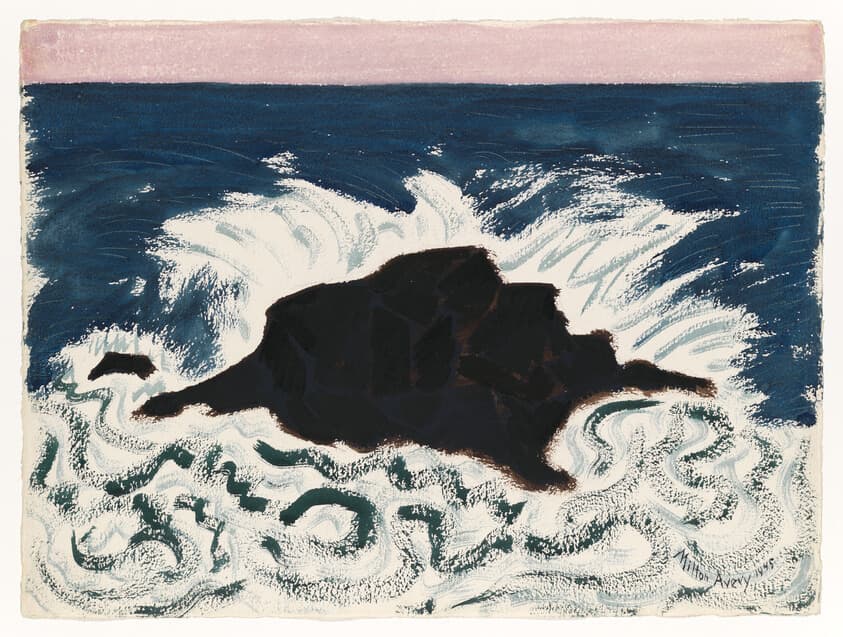
Equal space is given to each artist, but Avery’s presence dominates throughout. This is evident from the moment of entry, where a gathering of late masterpieces in subdued pastels and brooding blacks (notably 1945’s swirling and explosive watercolor Lone Rock and Surf ) roar and beckon in anticipation of the artist’s apotheosis before the exhibition commences in earnest with his early work of the 1920s.
While it is impossible to classify Avery as an Abstract Expressionist, his unflinching rejection of illusionistic depth in favor of broad expanses of color and simplified form led art critic Clement Greenberg to regard him as the movement’s unwitting progenitor.1 Rothko biographer James Breslin called him “the historical link between European modernism and the ‘color field’ wing of American Abstract Expressionism.”2 But the exhibition confirms Avery’s place as much more than just a precursor to the movement.
Shown alongside two giants that helped establish America as the heart of the postwar art world, he emerges as the exhibition’s cynosure, elucidating Rothko and Gottlieb’s gradual move to artistic independence. While it would take time for each of them to find their own visual language, Avery’s outsized influence can be measured as much by what Rothko and Gottlieb rejected as by what they absorbed.
Avery began summering in Gloucester during the early 1920s. Having rejected the expository principles of social realism that dominated 1930s American painting, he looked to European Modernism, where the decorative configurations of Henri Matisse suggested possibilities largely absent from contemporary American art.
Eighteen years older than his colleagues, Avery invited Rothko and Gottlieb to Gloucester in 1932 to paint side by side on the beaches of Cape Ann. Avery’s friend Louis Kaufman described the artist as teaching “not by what he said but what he did.”3 However, Rothko and Gottlieb resisted blind imitation as they preserved their artistic identities and gradually pulled away from Avery’s representational approach.
Rothko’s move toward psychological expression through color was already evident in his figurative work. One of the exhibition’s most revealing juxtapositions comes through two 1933 watercolors, both showing a woman seated on a sofa with a child on her lap. The quaint subject, portrayed twice in starkly different colors, exemplifies the artist’s early experiments with the ways in which color, when varied within the same composition, can manipulate mood. But the paintings themselves are dull, favoring explanation over visual punch, and the exhibit suffers from a profusion of watercolors that similarly serve as little more than didactic steppingstones.
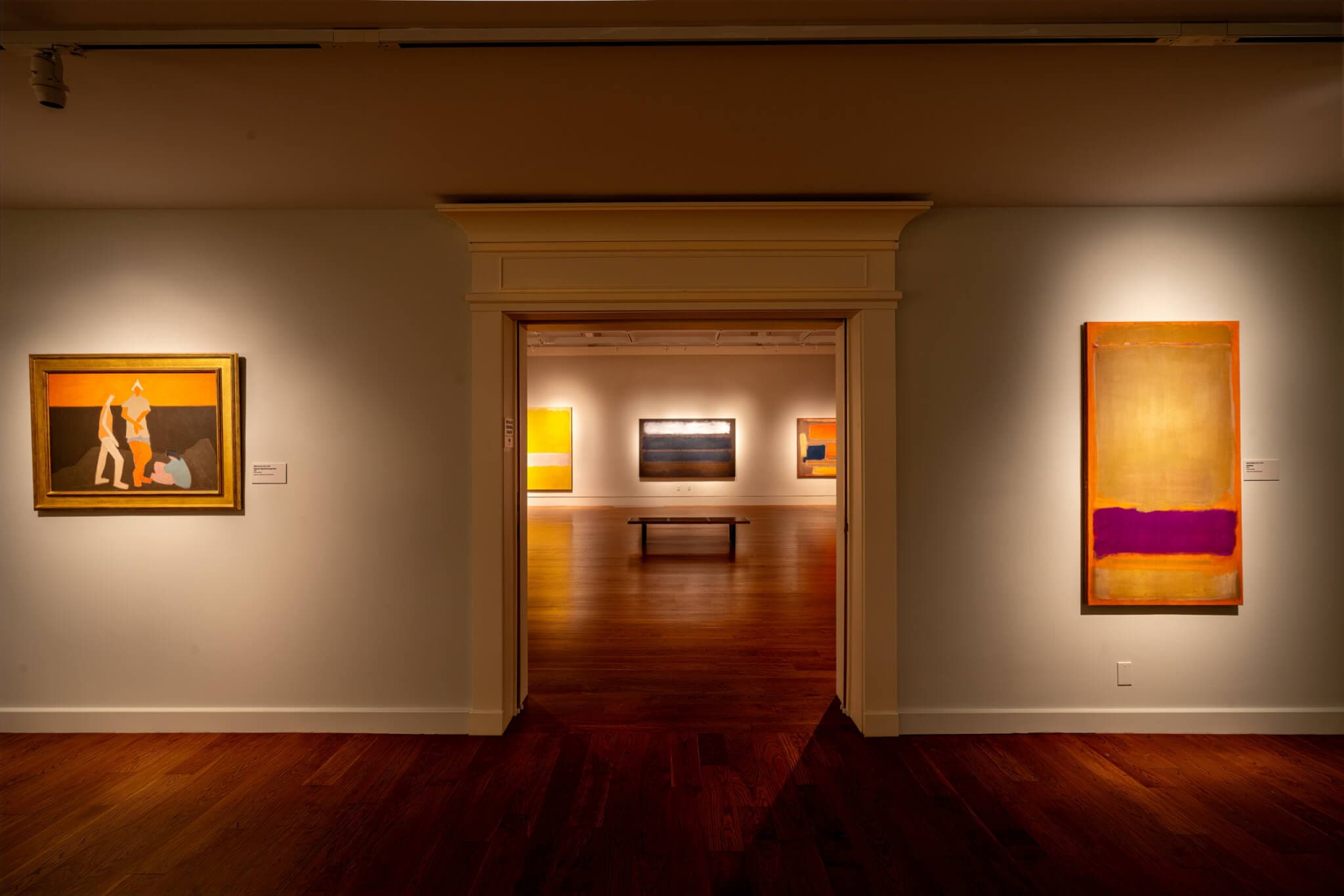
(left) Milton Avery, Figures Against Orange Sky, 1949. (right) Mark Rothko, Untitled, 1949. Installation view, “Avery, Gottlieb & Rothko: By the Sea,” Cape Ann Museum, Gloucester, MA, 2026. Photo by Steve Rosenthal. Courtesy of Cape Ann Museum.
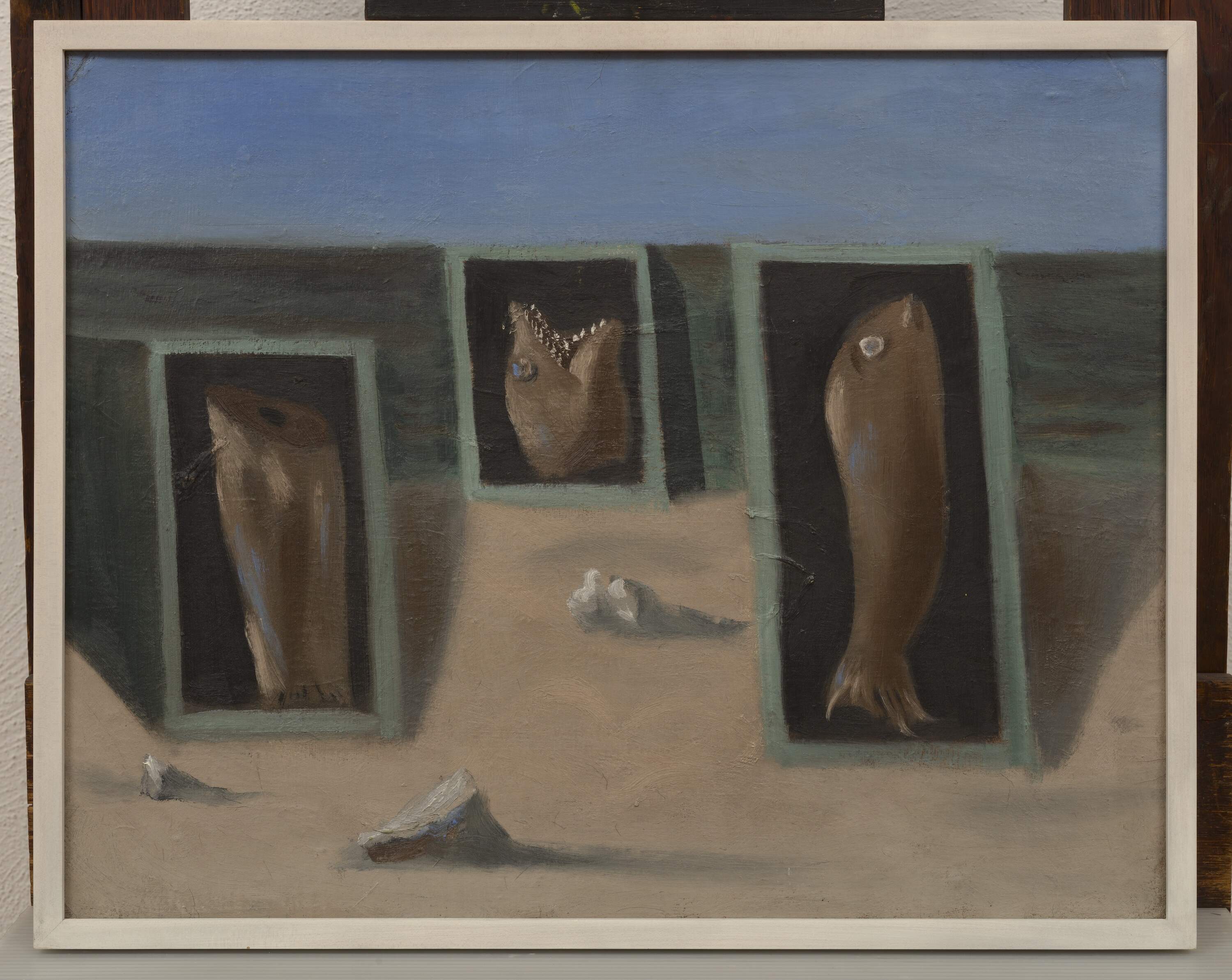
From the start, Gottlieb turned his attention away from the beach to the working wharves, where he painted in the subdued palette of Ashcan Realism. Attuned to the blows sustained by the seaport town amid the Great Depression, his early work largely reflects the decade’s economic hardship. Nowhere is this more affecting than an untitled 1936 oil in which a dockworker sits in gloom amid the struggling fisheries. With subtle menace, the troubled cove and fading dusk forecast the artist’s compelling, forlorn Surrealism of the early 1940s.
Avery’s critical acclaim continued to soar during the 1940s as Rothko and Gottlieb intensified their exploration of an aesthetic language by paring their imagery down to what they jointly described as “flat forms [that] destroy illusion and reveal truth.”4 Here is the decade where the exhibition’s chronology allows the viewer to fully witness the divergence of the three artists’ paths.
In 1943’s Iphigenia and the Sea, Rothko dismantled both figure and ocean to leave them identifiable but fractured in a vague landscape where brushwork is pulled and stretched by a variety of vertical shapes and marks as though on an assembly line. But it is 1944’s Birth of Cephalopods, in which rounded vertical forms swirl and writhe within a warm, boundless framework, that signifies the spontaneity with which the artist attempted, as Avery said of his own work, “to eliminate and simplify, leaving apparently nothing but color and pattern.”5 These liminal paintings are among the most explanatory in tracing the artist’s move from representation to abstraction.
Upon his return to Gloucester in the 1940s, Gottlieb began experimenting with the invented symbols that populate his “Pictograph,” series, spanning 1941 to 1950, which the artist insisted were not abstractions but rather realism refurbished for the modern age. At their best, they emerge as urgent, opaque communications. However, their occasional tendency to veer into the figurative and oceanic realms, as in the 1946 oil Forgotten Dream, comes across as little more than clumsy shorthand for a philosophy that’s never realized.
Following a radical divergence in artistic direction, the trio reunited in Gloucester in the mid-1940s. A second move, this time to the artists’ colonies of Provincetown in the 1950s, signals the summit of their individual identities.
Gottlieb’s so-called “Imaginary Landscapes” of the fifties are largely structured around bounded, circular forms hovering over unfettered, impulsive strokes. Deliberate contrasts that affirm flatness over illusory space, represented in 1959’s aptly titled Under and Over, ultimately read as a low-stakes competition between garbled form and something resembling chaos.
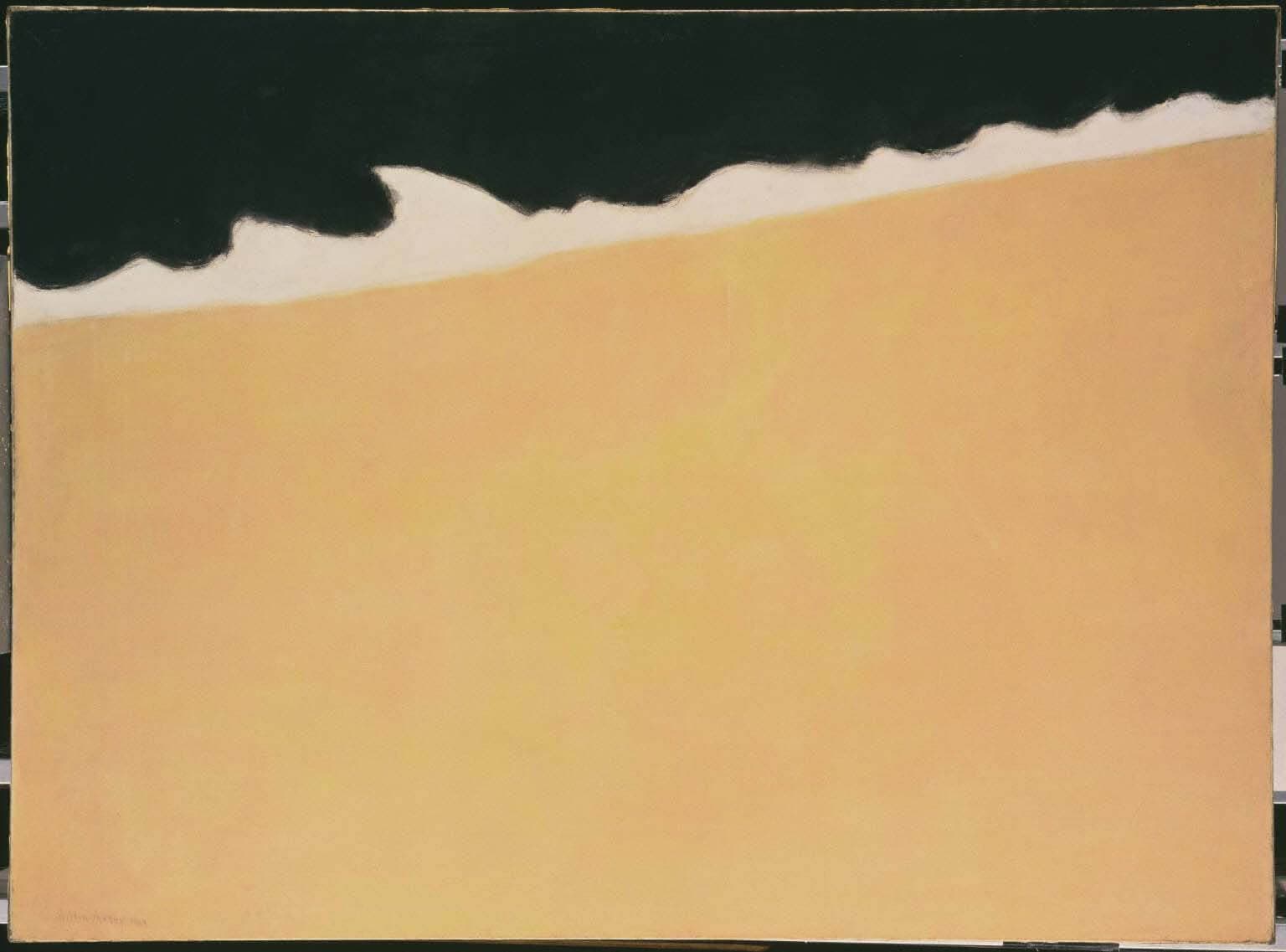
Avery continued to simplify his compositions by juxtaposing broad expanses of color. This is brilliantly realized in the almost entirely abstract Black Sea (1959), where a diagonal white stripe of breaking seafoam rises like teeth between a dominant orange-yellow and coal-black water. As Rothko and Gottlieb were creating wholly abstract languages, the masterpiece serves as a reminder that Avery’s heart remained forever bound to the edge of the sea.
—1 Heather Atwood, “Color of Light Screening: Joseph Solman” lecture, Sawyer Free Library, Gloucester, MA, July 10, 2026.
—2 James E. B. Breslin, Mark Rothko: A Biography (University of Chicago Press, 1993), 95.
—3 Breslin, 94
—4 Rathbone, Eliza, ed. Avery, Gottlieb & Rothko: By the Sea. (Rizzoli Electa, 2026), 35.
—5 Rathbone, 33
—6 Sanford Hirsch, The Beginning of Seeing: Tribal Art and the Pictographs of Adolph Gottlieb (New Britain Museum of American Art, 2002), 5.
/wp-content/uploads/2023/08/logo.png00Haley Wolfe/wp-content/uploads/2023/08/logo.pngHaley Wolfe2026-08-18 15:44:142026-08-18 15:47:31Boston Art Review: “Avery, Gottlieb & Rothko: By the Sea” Shows How Three Midcentury Greats Were Shaped by the Shore and One Another
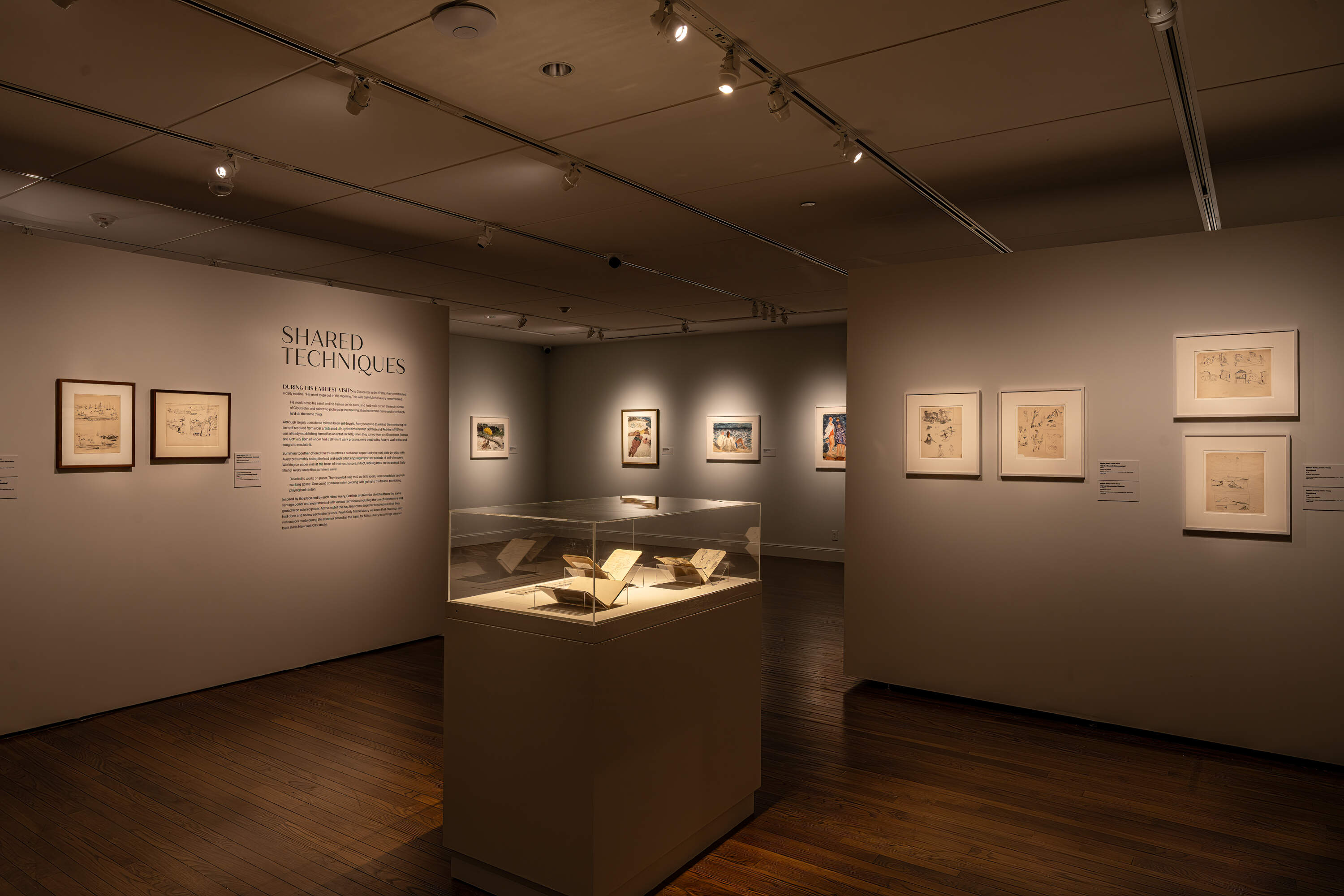
A gallery at the Cape Ann Museum for the show “Avery, Gottlieb and Rothko: By the Sea.”/ETHAN M. FORMAN
GLOUCESTER — “Avery, Gottlieb and Rothko: By the Sea” at the Cape Ann Museum for the first time tells the story of how the three artists and friends were influenced by the fishing industry, granite coast and tourist beaches of America’s oldest seaport where they spent several summers together in the 1930s and 1940s.
Two of these three great 20th century artists were Jewish, but that was not what brought them together, experts say. Instead, it was friendship, mentorship, and a love of Cape Ann.
The exhibition, which runs through Sept. 27, coincides with the reopening of the newly renovated Cape Ann Museum’s downtown campus thanks to a successful $23 million fundraising campaign in time for the museum’s 150th anniversary.
“Avery, Gottlieb and Rothko: By the Sea” consists of 82 works that trace how Gloucester and Cape Ann may have informed the artists’ later abstract work.
Mark Rothko, Untitled, 1949. Oil on canvas, collection of Kate Rothko Prizel, on display at the Cape Ann Museum./ETHAN M. FORMAN
Abstract expressionist painters Adolph Gottlieb, known for his pictograph paintings; and Mark Rothko, known for his large rectangular color field canvases, were both Jewish. Modern painter Milton Avery was not. Avery’s wife, Sally Michel Avery, however, was an artist who came from a Jewish family of immigrants from Brooklyn, according to a retrospective of her work at the Morris Museum (in Morris Township, New Jersey) in the spring of 2025 on jerseyarts.com.
Judaism did not play a role in their friendship, and the artists were not religiously observant, said the exhibition’s guest curator, Eliza Rathbone.
Their work transcended religion, she and others said.
“I don’t think that fact [that Rothko and Gottlieb were Jewish] had much to do with why they were friends,” Rathbone said. “They were friends because they were friends, and the two younger ones were quite entranced [with Avery].”
Milton Avery was 18 years older than Rothko and Gottlieb, and he became their enduring friend and mentor after they met around 1929.
Sally Michel met Milton Avery in Gloucester in 1924. They married in 1926. She worked as a commercial illustrator to support the family.
Gottlieb’s personal identity did not play a role in his art, according to notes for an exhibition at the Jewish Museum in 2002-2003.
“The idea of being a so-called Jewish artist is like being a professional Jew,” Gottlieb reportedly said. “I think art is international and should transcend any racial, ethnic, religious, or national boundaries.”
Rothko’s work is steeped in spirituality, mythology, and human emotions outside the confines of organized religion.
Rathbone said Rothko, born Marcus Rothkowitz in 1903 in Dvinsk, Russia, now Daugavpils, Latvia, came to the United States with his family at age 10 where they settled in Portland, Oregon.
In Latvia, Rothko was the only member of the family to attend a cheder, a Jewish school, where he studied Hebrew.
“I like to think about the fact that Mark Rothko … when he was still a boy in Latvia, he was the only one of his family to go to a traditional Jewish school,” Rathbone said.
After moving to the U.S, he turned away from organized religion, according to an October 2023 article in The Jewish Chronicle of London featuring an interview with Rothko’s son, Christopher.
“I think it was a significant factor for him and his inclination to be very intellectually inquiring and interested in the spiritual dimension of things,” Rathbone said.
This spiritual aspect of his work became “all embracing,” she said.
Cape Ann Museum Director Oliver Barker./ETHAN M. FORMAN
In April, Rathbone had just returned from Florence where there was a major Rothko exhibition, “Rothko in Florence.” She said it was co-curator Christopher Rothko’s idea to introduce five of his father’s paintings into cells at the Museo di San Marco with Renaissance frescoes by Fra Angelico.
“There’s this unprecedented juxtaposition of a work by Rothko in a cell with a fresco by Fra Angelico,” she said.
Growing up, Rothko earned a scholarship to Yale. He went there for two years before moving to New York to become an artist, Rathbone said.
In a 1982 oral history interview for the Smithsonian, Sally Michel Avery recalled Rothko telling her he was unpopular and unhappy at Yale.
“Well, he was very Jewish and Yale was very WASP-ish,” said Sally Michel Avery. “He was very bored with the curriculum. And he just felt like sort of an odd fish.”
In New York, Rothko taught at the Center Academy of the Brooklyn Jewish Center for about 20 years, according to his bio with the “Rothko in Florence” exhibit.
In 1935, he founded the artist group called The Ten, along with Gottlieb. Most of the artists in this group were Jewish.
Sanford Hirsch, the Adolph and Esther Gottlieb Foundation’s executive director, said Gottlieb recognized “he was culturally and ethnically Jewish, but it didn’t inform his art in a direct way.”
Gottlieb did a few different projects for synagogues, two of which were stained glass projects, and two involved fabricating a Torah curtain and valance, Hirsch said.
“I don’t think of the work that I did for the synagogues as religious art because I’m not a religious person in the sense of practicing any form of religious beliefs,” said Gottlieb in an excerpt of a 1962 interview with Martin Friedman.
Adolph Gottlieb’s work at Temple Beth El in Springfield, Massachusetts in 1953./Photo by L.H. Frohman, courtesy of the Adolph and Esther Gottlieb Foundation
One of the projects Gottlieb worked on was a Torah ark at Temple Beth El in Springfield, Massachusetts. However, the temple suffered a fire in 1965, and the work was lost, Hirsch said.
In 1953, Gottlieb was commissioned by an architectural firm to create a five-story, free-standing stained-glass facade for the Milton Steinberg House, which at the time was the community center and offices for Park Avenue Synagogue, according to the Gottlieb foundation’s website. The work was dedicated in 1954 and dismantled in 1980, although individual panels still exist.
Gottlieb was born in 1903 and raised in New York City. Gottlieb’s parents had emigrated from Bohemia when they were both 5 years old, Hirsch said. Gottlieb was born on East 10th Street to parents who were assimilated. Gottlieb did not have a Jewish education growing up – Esther Gottlieb told Hirsch that Adolph Gottlieb “had to be bribed to be bar mitzvahed.”
Hirsch said Gottlieb changed the spelling of his first name from “Adolf” to “Adolph” in 1933 in response to Hitler’s rise to power.
Avery, who came from humble beginnings in Hartford, Connecticut, showed Gottlieb and Rothko they could pursue a career as an artist, and they responded to his work ethic, Cape Ann Museum Director Oliver Barker said.
“Their religion may not have always been at the forefront of their work, but it certainly very much informed everything that they were creating,” Barker said. Θ
/wp-content/uploads/2023/08/logo.png00Haley Wolfe/wp-content/uploads/2023/08/logo.pngHaley Wolfe2026-08-14 10:56:012026-08-14 10:56:46Jewish Journal: See ‘Avery, Gottlieb and Rothko: By the Sea’
/wp-content/uploads/2023/08/logo.png00Haley Wolfe/wp-content/uploads/2023/08/logo.pngHaley Wolfe2026-08-07 14:25:012026-08-07 14:25:01PBS News: Exhibition reveals how summers by the sea shaped three great American painters
At the Cape Ann Museum, the overlooked connection between the three artists, forged during their shared summers in Gloucester, Mass., is brought to light.
Installation view of ‘Avery, Gottlieb & Rothko: By the Sea’ at the Cape Ann Museum.Steve Rosenthal, 2026.
Gloucester, Mass.
In the 1930s and ’40s, three friends—all artists, one almost a generation older than the others—spent their summers here, sketching and painting the picturesque environs of America’s oldest continuously operating seaport. They are known for very different styles: Milton Avery (1885-1965) for his colorful, flat, figurative scenes; Adolph Gottlieb (1903-1974) for his abstractions, especially those featuring a sun-like orb over a burst of color; Mark Rothko (1903-1970) for his color-block paintings evoking emotion, not image.
Even serious art-lovers might fail to see links among them. Yet as “Avery, Gottlieb & Rothko: By the Sea” at the Cape Ann Museum reveals, their friendships, their summers and their mutual admiration critically influenced their artistic paths. By the time visitors reach the exhibition’s last gallery in this newly renovated museum, which reopened June 30 after a 20-month upgrade, they can’t help but observe the connections.
Credit for this surprising exhibit goes to Eliza Rathbone, chief curator emerita at the Phillips Collection in Washington—which has long associations with all three artists—who decided to bring to light a story that to some had been known, but never truly shown. She dug into troves of paintings and drawings, some owned by family members, and chose more than 80, many of which have never been displayed in public, that make the point.
The exhibition, which runs through Sept. 27 and then moves to the Phillips, follows both a chronological and thematic path. It starts soon after Avery initially arrived in Gloucester for the summer of 1921. His “Gloucester Dawn” (c. 1921) and “Untitled (Harbor Scene)” (c. 1921-25) exhibit impressionistic tendencies, perhaps inspired by Monet. By the end of the decade, though, he’d shifted to flatter, less brushy scenes.
Later that decade, Avery befriended Rothko and then Gottlieb, and by 1932 all three were summering in Gloucester, spending their mornings sketching or painting the harbor, the wharfs, the sea, the beach and the bathers. In the evenings, they discussed their work, with Avery as mentor at first.
Judging by a wall of Avery’s 1930s beach scenes—lighthearted sketches and watercolors of people enjoying the ocean, with one even called “Untitled (Lazy Afternoon)”—he clearly moved to a more modern mode, deploying loose lines and bright colors.
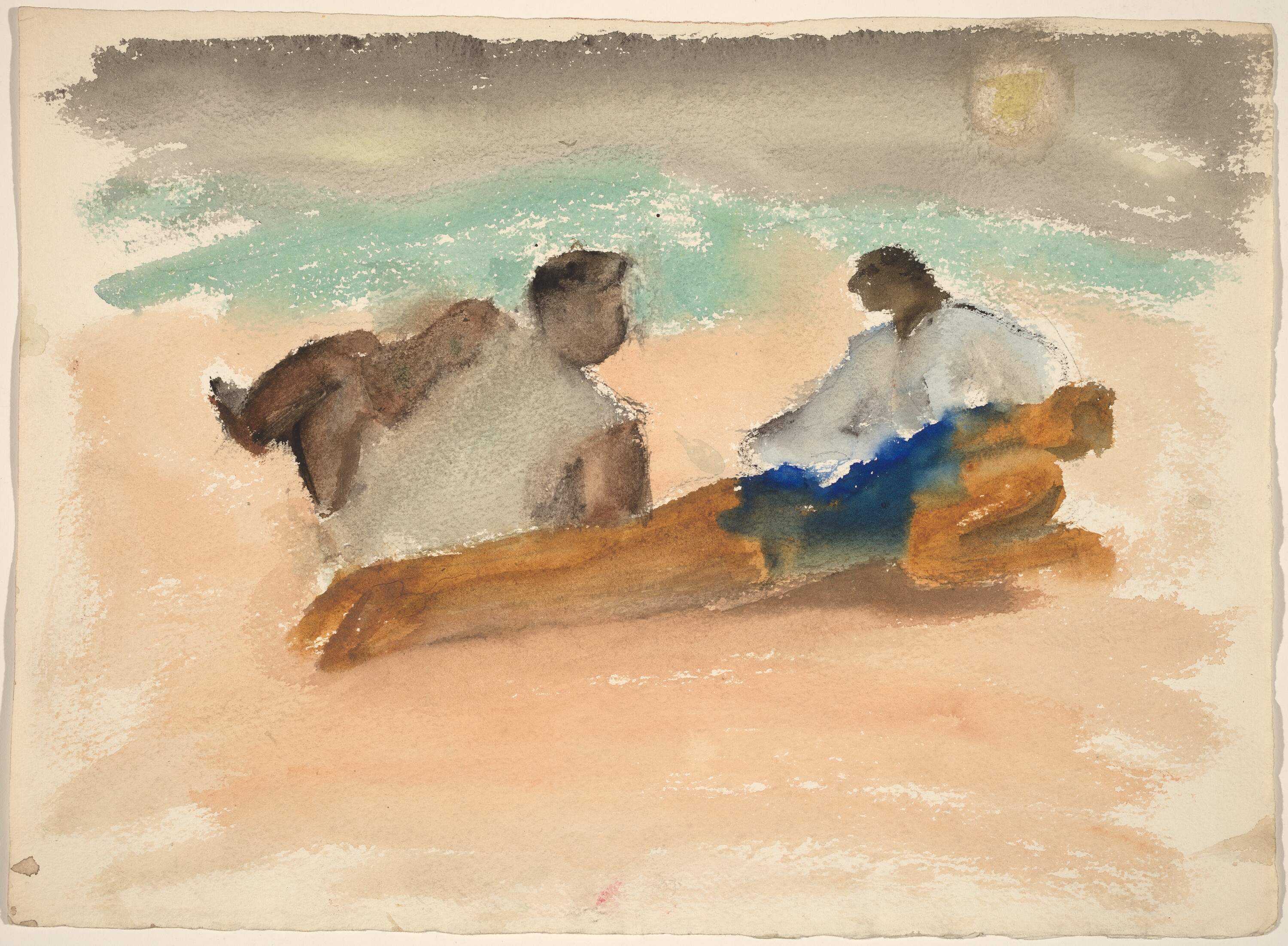
Rothko, meanwhile, also painted bathers—a little clumsily, like Cezanne’s. He also created several small, realistic earth-toned scenes of the town, such as “Untitled (Wharf, Gloucester, Massachusetts),” from 1934, which portrays fish processing on the waterfront. Gottlieb seems even more drawn to the industrial aspects of the port. His “Harbor Scene Gloucester?” (c. 1934); “Rockport” (c. 1936), made in the less gritty town up the Cape; and “Wharf in Gloucester” (undated) look almost somber. Rather than people, his focus is on shells and other sea detritus, which he arranged in discarded crates.
These crate paintings lay groundwork for Gottlieb’s pictograph series, which would become a signature for him. In “Mariner’s Incantation” (1945), for example, he placed simplified images of fish, faces, a hand and nautical symbols in a blue-green grid—a step toward abstraction that blends in Surrealism. Rothko also begins to flirt with Surrealism—which becomes more pronounced in his output as the tragedies of World War II unfolded. His works here, like “Iphigenia and the Sea/Horizontal Phantasy” (1943) and “Abstract Composition” (1944), place the sea as a backdrop for his musings on myth and the unconscious. Such overt connections with Gloucester would soon fade.
Already established by the 1940s, Avery’s work grows simpler, more expansive, flatter and with larger color blocks, but his images remain tethered to the real world. In “Lone Rock and Surf” (1945), he provides only the essential elements of a scene—frothy white waves crashing against a black rock, with a stripe of pink for the sky. Edging toward abstraction, his “George Constant Fishing” (1945) also strips the image down to its necessities. Constant, standing on a striped rock, consists of two color patches; the rest is largely blue sea, topped by a light-gray strip of sky.
Everything comes together in the final gallery, where each artist commands a wall of paintings. The links, often subtle, seem intuitively clear. Avery once said he wanted to create big works “like the Abstract boys”—and he has. “Sea Grasses and Blue Sea” (1958), at 5 feet across, presents two triangular blocks of different blues, one daubed with black, beneath a turquoise strip of sky. “Black Sea” (1959), at more than 5 1/2 feet wide, shows an expanse of peach sand, bubbling white water and a sliver of deep-sea black. A small work, “Moon Lit Sea” (1959), floats a greenish sphere over its orange reflection in a black background—shades of both Gottlieb and Rothko.
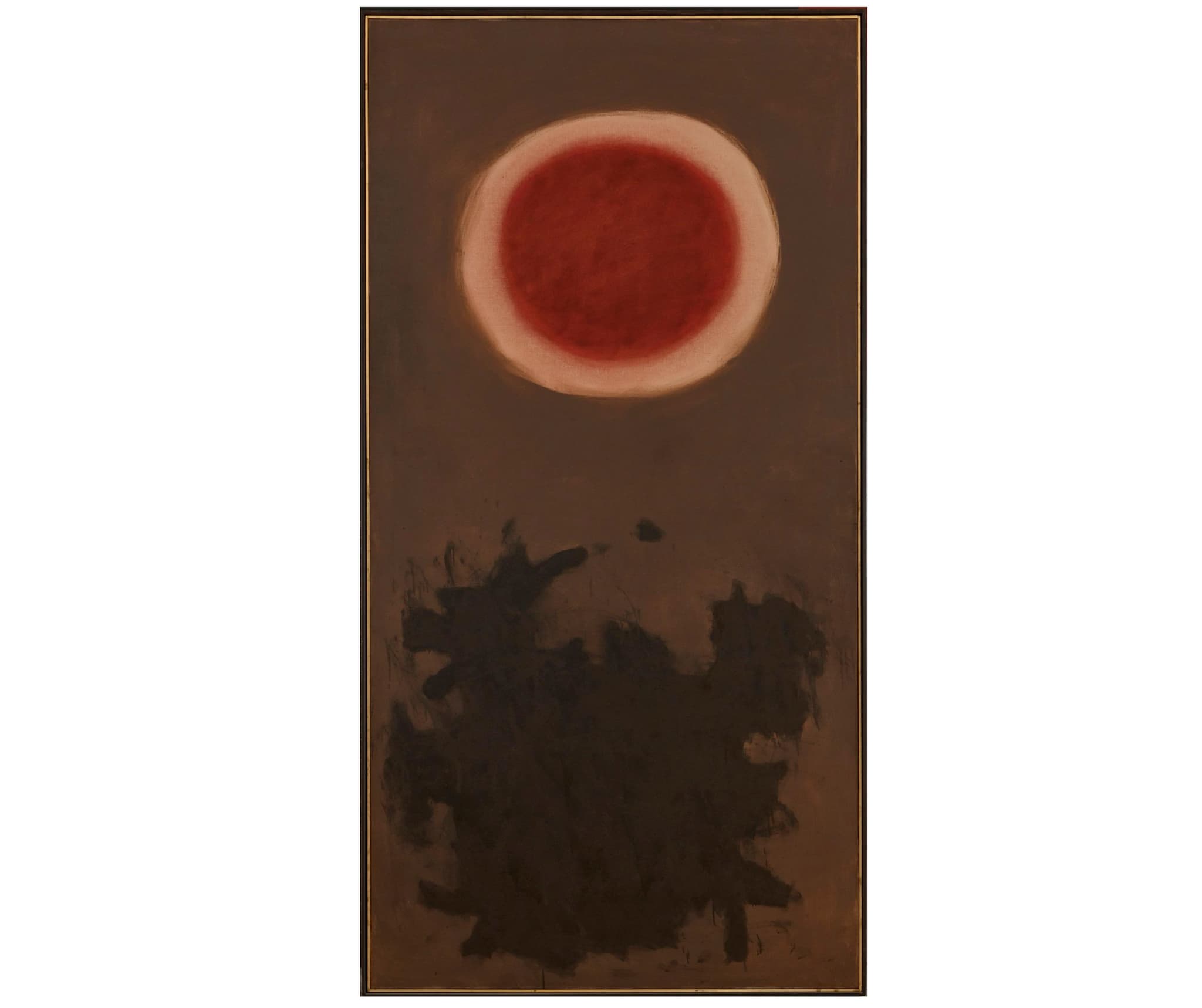
On Rothko’s wall, “No. 14 (Horizontals, White Over Darks),” from 1961, might be a darker version of “Black Sea,” while “No. 20” (1949) picks up the architecture of Gottlieb’s crate paintings and pictographs. And suddenly Gottlieb’s “Under and Over” (1959), a quintessential burst painting with a glowing red orb over black splotches, reads like some of Rothko’s dark color-block works. Gottlieb’s bright “Blue at Night” (1957) imagines a seascape.
All three men are now intently focused on color and simple forms, an interest developed, refined and tailored to their own visions in Gloucester, a place that affected the rest of their careers and a period of American art.
/wp-content/uploads/2023/08/logo.png00Haley Wolfe/wp-content/uploads/2023/08/logo.pngHaley Wolfe2026-08-03 16:40:042026-08-03 16:40:53The Wall Street Journal: ‘Avery, Gottlieb & Rothko: By the Sea’ Review: Illuminating an Unlikely Kinship
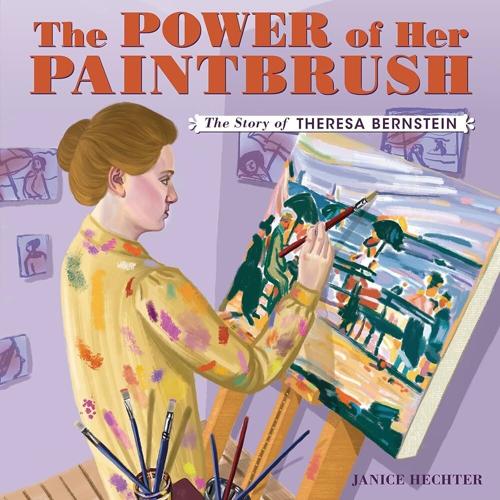
The Power of Her Paintbrush: The Story of Theresa Bernstein, by Janice Hechter
Theresa Bernstein, a singular woman artist who had a remarkably long career and lived to well over 100 years old, inspired a children’s picture book about her life.
Bernstein (1890–2002), who married artist William Meyerowitz, was among the many celebrated artists who summered in Gloucester. She made her first visit to Cape Ann in 1916, and she and her husband were familiar faces of the Rocky Neck Art Colony. They had friendships with artists such as Stuart Davis, Edward Hopper and Josephine Nivison, according to her bio.
To celebrate the release of “The Power of Her Paintbrush: The Story of Theresa Bernstein,” and the artist, Cape Ann Museum will host two programs this Saturday, July 25, with Janice Hechter, the book’s author and illustrator.
Hechter first will lead a one-hour family program at 10:30 a.m. at the new Education Studio at Cape Ann Museum’s downtown campus, 27 Pleasant St. in Gloucester, where she will introduce children to the artist and share her own journey about research for the creation of this new book. The session will include a reading and art activity inspired by Bernstein’s work.
In the afternoon, Hechter will present another one-hour program at 1 p.m. in the downtown museum’s Library & Archives. The talk will explore her research process and approach to telling the story of Bernstein, a Modernist painter who lived and worked on Cape Ann during the 20th century.
Bernstein studied at leading schools of art, including the Pennsylvania Academy of Art, the Philadelphia School of Design for Women, and the Art Students League in New York.
Hechter, who lives in central Connecticut, is a writer and illustrator of children’s books. She always planned on creating a book about an artist because she too is an artist.
“When I researched picture books about artists, I noticed that almost all of them were about male artists. I even came upon a picture book series of 20 different historical artists. But out of those, only one depicted a woman,” she said. “It brought me back to when I was an art student in college, and the only historical artists that we learned about were men.”
When Hechter often visited art museums in New York City at the time, she found most most of the historical artworks on display were created by men, and at the time, she never questioned the lack of women artists.
“I just took it as a given that only male artists from history received recognition,” she recalled. “More recently, I wondered, did women artists exist in centuries past? Were they somehow just not as successful as their male counterparts? I did some research and discovered Theresa Bernstein. I was immediately taken by Bernstein’s ability to capture the energy of a moment in time. Her paintings of gatherings of people depicted an excitement that pulled me in. I wanted to learn more about this artist.”
Hechter dove deep into her research for this new book, which included interviews with some of Bernstein’s friends and relatives and watching videos of the artist talking about her work. Hechter read both an autobiography and biography about Bernstein, and poured over articles, reviews of her work, sketches, and went to view some of her drawings and paintings in person — and she knew she had found a consummate artist about which to write for her next book.
This program coincides with the museum’s recent acquisition of a significant work by Bernstein, a self-portrait depicting the artist as a young woman and already a successful artist, likely painted around 1916. The museum’s collection also includes additional works by Bernstein and Meyerowitz.
“Theresa Bernstein’s story is one of remarkable perseverance, creativity, and vision,” museum Director Oliver Barker said. “We are delighted to welcome Janice Hechter to share Bernstein’s legacy with younger audiences in such an engaging and accessible way. This program reflects our ongoing commitment to connecting the community with the rich artistic history of Cape Ann while inspiring the next generation of artists and storytellers.”
/wp-content/uploads/2023/08/logo.png00Haley Wolfe/wp-content/uploads/2023/08/logo.pngHaley Wolfe2026-07-24 15:54:122026-07-24 15:54:12Gloucester Daily Times: Celebrating Theresa Bernstein: Museum hosts programs with author about artist
Mature works by Mark Rothko in the chapel-like gallery of “Avery, Gottlieb & Rothko: By the Sea,” at the Cape Ann Museum. Steve Rosenthal/Cape Ann Museum
GLOUCESTER — Can an exhibition anchored by the works of Mark Rothko be endearing? Yes, it turns out, though I never would have guessed. With his wildly famous banks of colored fog hovering in space in all their consuming glory, Abstract Expressionism’s high priest of the gloomy sublime tends to inspire different terms. An experience of Rothko works is for some spiritual; for others, quietly overwhelming in its emotional force.
But sweet? That’s something new, at least for me. But that’s the flavor of “Avery, Gottlieb & Rothko: By the Sea,” the legitimate summer blockbuster just opened at the Cape Ann Museum in Gloucester. The show announces notable landmarks of at least a couple of sorts: It’s the first to explore the bond that Rothko, his AbEx confrere Adolph Gottlieb, and their mentor Milton Avery forged over shared summers on Cape Ann, a formative crucible of American art’s most significant moment; and the return of the Cape Ann Museum itself, after a year and a half of renovation.
Late works by Adolph Gottlieb at “Avery, Gottlieb & Rothko: By the Sea,” at the Cape Ann Museum. Steve Rosenthal/Cape Ann Museum
If you want to start with a bang, this is tough to beat. Curator Eliza Rathbone, formerly of the National Gallery of Art and the Phillips Collection and now a full-time Gloucesterite, delivers the necessary fireworks right up front. One expansive gallery here is a smoldering realm of painterly wonder: One wall is given to three mature Rothko paintings, uncanny in their inscrutable splendor; another, to Gottlieb at his peak, with his jagged primal forms swiped urgently on the canvas; and another, to Avery, the elder, brushing aside the abstract urges of his young charges with an impish tease.
I feel confident saying it’s one of the best rooms you’ll see in an American museum this summer, but more on that in a bit. This is the destination, the trio fully formed; the journey, meanwhile, awaits. In the entry hall, Rathbone grounds her subjects in the abiding friendship that underpinned their artistic communion: Avery’s warmhearted portrait of Rothko smoking his pipe, Gottlieb’s sketch of Avery at his easel.
Milton Avery, “Portrait of Mark Rothko,” 1933. Rhode Island School of Design Museum, Providence. Milton Avery Trust/Artists Rights Society
It sets the scene with genuine affection and an appreciation for their precious shared moments. A 1957 Avery painting of stubby gulls keening over the marshy beaches of the North Shore hints at the seaside idyll; Rothko’s loving watercolors of a woman nuzzling the small child folded into her lap tips to familial bliss, and maybe something more: The softness of form, the seepage of paint, signals of the catalytic era yet to come.
To be fair, hindsight is a pretty easy read. These little Rothkos, painted in the early 1930s right here in Gloucester, speak less to clairvoyance and more to the artist’s adoration of Modern masters Henri Matisse and Paul Cezanne, who he aped but couldn’t quite emulate (Rothko, by his own admission, struggled with the fiddlier parts of figure painting, like hands and faces).
Milton Avery, “Untitled (Man & Nets),” no date. Installation view, “Avery, Gottlieb & Rothko: By the Sea,” at the Cape Ann Museum. Murray Whyte/Globe Staffx
But nothing comes from nothing, and this show is here to make that much plain. Cross the hallway from the cathedral-like setting of the trio at their peak, and you’ll find a stroll through the artists’ formative years. Avery takes the starring role here; he was the Gloucester devotee who lured his young charges north from New York, where they’d met at the Art Students League.
Avery was a misfit in a great many ways, all of them finally adding up in recent years to one of the most important and unique careers in American art. For him, Gloucester had lineage: From Luminist forefather Fitz Henry Lane to Winslow Homer to John Sloane, Stuart Davis, and Marsden Hartley, its rocky shores and unearthly northern light had inspired generations of artists.
Mark Rothko, “Untitled (wharf, Gloucester, Massachusetts),” 1934. National Gallery of Art, Washington, D.C.Kate Rothko Prizel & Christopher Rothko/Artists Rights Society
His little paintings of boats and harbors are a marvel, a clever fusion of the blooming Modern sensibility of the time and the local maritime heritage: The shadowy ruptures of “Untitled (Man & Nets),” which has no date, brims with an exuberance for color and form, almost disconnected — but not quite — from the dock and black water it so loosely captures. “Gloucester Dawn,” 1921, swims in a haze of yellow morning heat bouncing off a still sea, and casting the boats in a wavering shimmer; “Gorton’s Dock,” 1931-34, piles up the rough shapes of mast and sail, pier, shack, and hull in a mound of hectic form.
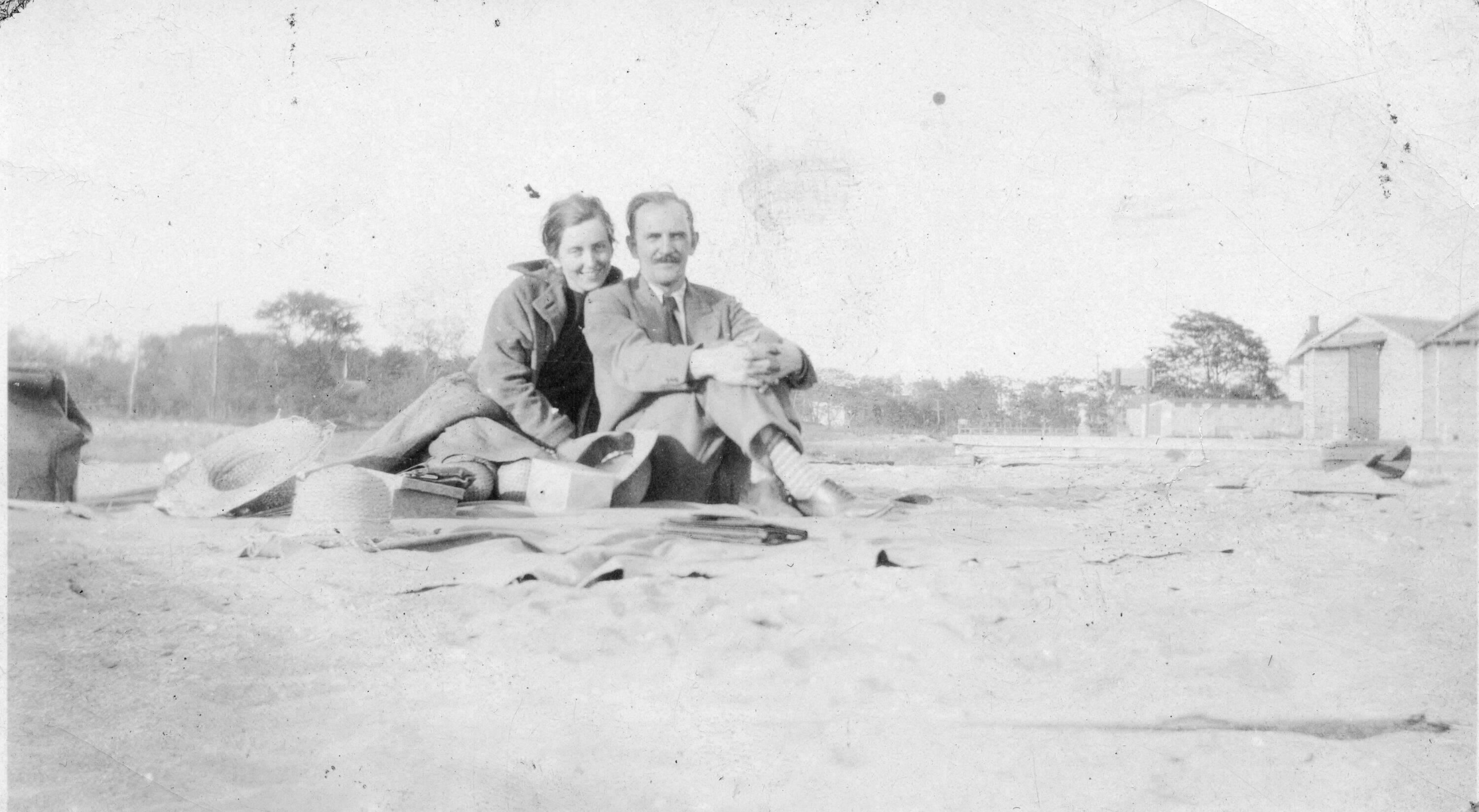
When Avery started spending summers there, artists were everywhere, though fewer of the Modern cast than he favored. He decided to bring his own; he extended the invitation to Gottlieb and Rothko — urbane, serious, intellectually driven — to maybe help them lighten up a little bit. It worked — one of the real pleasures of the show is a snapshot of Rothko on the title wall, lounging in the soft sands of Good Harbor Beach, an unexpected dash of casual repose — but it wasn’t a slackening of pace as much as an invigorating refresh.
Mark Rothko, “Untitled (Figures with Gill Net Reels),” 1934. Installation view, “Avery, Gottlieb & Rothko: By the Sea,” at the Cape Ann Museum.Steve Rosenthal/Cape Ann Museum
In the harbor, the three come together with diverging interests: Gottlieb’s “Rockport,” 1936, captures his dismay at the Depression and the death of industry it wrought; a denuded landscape in mud-brown, its lonely, vacant shacks are ramshackle and untended. Alongside them both, Rothko was reaching for new ground: An untitled 1934 watercolor of a Gloucester wharf seems to almost dissolve into mist before your eyes — the drying racks for salted fish just a slash of bright white, the wharf house itself being swallowed by fog.
Extract whatever narrative you like from that, but it snaps together with a cannily chosen companion right next to it, another untitled piece from the same year of men tending gill net reels. It pushes that much further: With its angular slashes of color barely assembling into a coherent scene, it teases at an artist on the edge of destiny, looking down and contemplating the plunge.
Milton Avery, “Untitled (Rothko with March),” 1930s. Installation view, “Avery, Gottlieb & Rothko: By the Sea,” at the Cape Ann Museum.Steve Rosenthal/Cape Ann Museum
How much did Gloucester inspire the leap? There are hints, and you may draw your own conclusions. What’s clear, though, is how much it provided all three men room to breathe, time to think, and the gift of communion. Away from the steamy cauldron of a New York summer, experiments were looser, freer; leisure was embraced, not scorned. An array of Avery’s beach scenes, loose and immediate, unspool countless carefree hours; one, of a young Rothko resting on a propped elbow in the sand with Avery’s infant daughter March is an absolute treasure. Rothko’s versions of the same surprise and delight: Soft bleeds of figures in repose, hunkered on horizontal bands of sand, sea, and sky that might portend what’s to come.
The show embraces that evolution: It tracks Gottlieb’s interest in Surrealism with a pair of 1930s paintings of found objects — shells, seaweed, molted skin of unknown creatures — arrayed in a box and left on the shore; and then, in the ’40s, his turn to pictograms en route to the pure abstraction to come. Alongside, Rothko abandoned his breathy renderings of beach and wharf for amoeba-like swirls of chaos (remember the gill nets?). Avery, meanwhile, remained moored to the seen and known, as he always would.
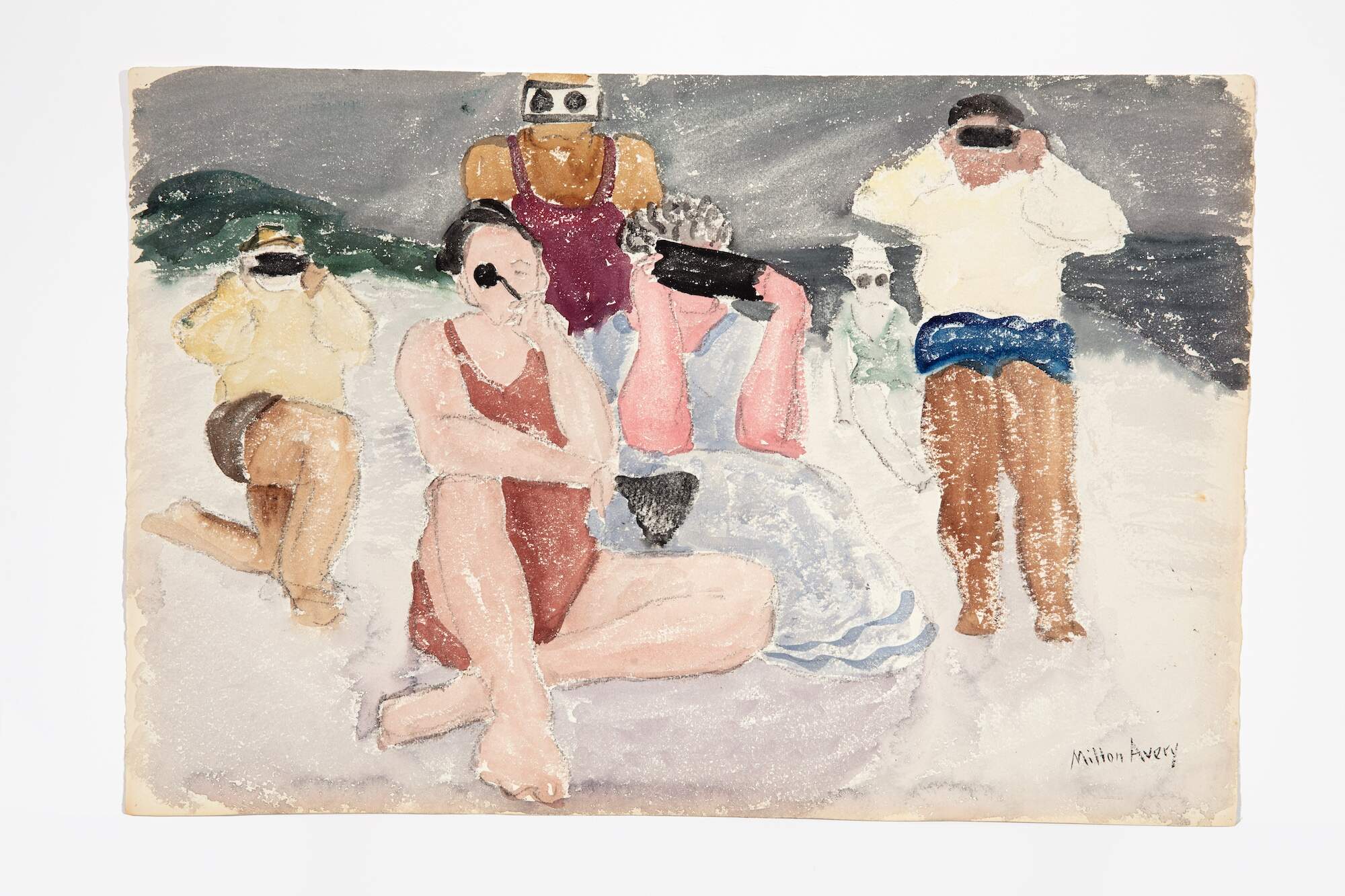
Mark Rothko, “Untitled (bathers on the beach),” 1934. Collection of Christopher Rothko. Kate Rothko Prizel & Christopher Rothko/Artists Rights Society
Which brings us all the way back around, to that near-holy ground of American art at the very beginning. Look again at these great big canvases, purposefully unmoored from the known world as Gottlieb and Rothko, more than anyone else, sought to drive painting into a realm of only color and form, apart from things you could hold and touch.
Avery riding alongside here is not a misfit anomaly. He’s the “but wait:” he watched as his younger friends built an Abstract Expressionist manifesto and pursued it full bore; he scaled up to meet the enormous canvases they began painting, but never followed their path. I see him, in a way, as their conscience: Just because you’ve abandoned the world, he seems to say, doesn’t mean it ceased to exist.
Milton Avery’s late works in the chapel-like room of “Avery, Gottlieb & Rothko: By the Sea,” at the Cape Ann Museum. Steve Rosenthal/Cape Ann Museum
In this glorious room, Avery’s “Black Sea,” 1959, hangs next to a suite of Rothko’s simmering abstractions, but defers to them not at all. A searing swath of sand curves up and to the right of the frame, a froth of white limning the shoreline from the dark water above.
A tease? Maybe. It’s that close. In “Red Sky, Blue Sea,” a little watercolor here, Avery seems to take a poke at Rothko with a composition that is pretty clearly a Rothko take-off; by naming its elements — all just indistinct blocks of color — there’s surely some playful subversion. But Avery was as dead serious in his pursuit as the younger renegades. He stood his ground as the world shifted beneath him — away, by midcentury, from depictions of the real and into the explosive abstraction that would for the first time make America the center of the art world. Avery had given his younger friends all that he could. This much, he would gladly keep forever for himself.
AVERY, GOTTLIEB & ROTHKO: BY THE SEA
At Cape Ann Museum, 27 Pleasant St., Gloucester. Through Sept. 27. 978-283-0455, www.capeannmuseum.org
/wp-content/uploads/2023/08/logo.png00Haley Wolfe/wp-content/uploads/2023/08/logo.pngHaley Wolfe2026-07-10 09:30:242026-07-10 09:30:24Boston Globe: From Gloucester with love: Rothko, Avery, and Gottlieb’s summer bond shines at the Cape Ann Museum
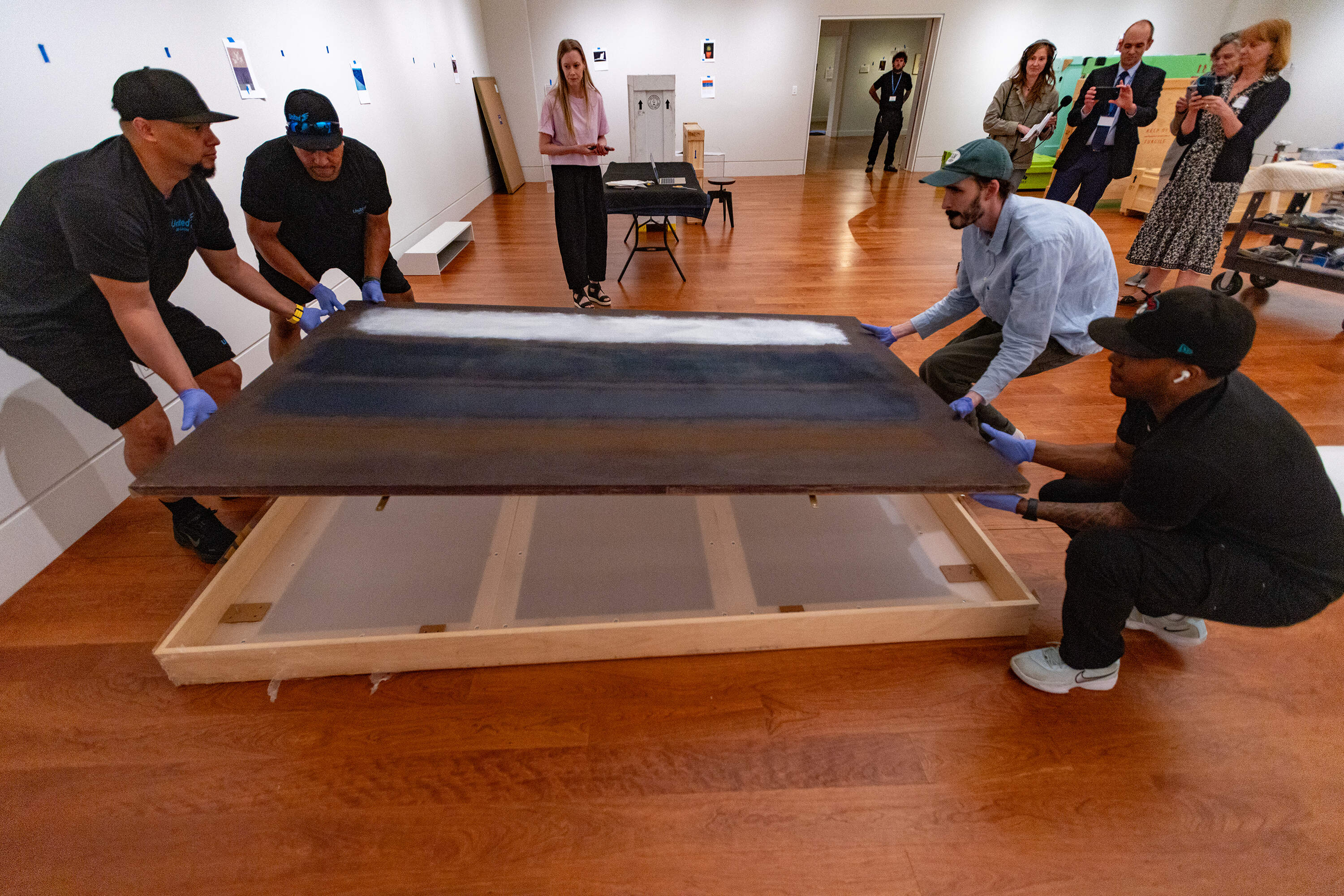
On a recent June morning, Cape Ann Museum director Oliver Barker basked in the presence of a heavy, wooden crate that had traveled to Gloucester from New York. It contained a large canvas he was giddy to greet.
“I’ve been working for museums for 30 years, and I would say this is perhaps one of the most exciting moments,” he said. “This work by Mark Rothko was a late addition to our exhibition check list.”
Rothko’s huge, late-career paintings routinely break multi-million dollar records at auction houses. But the celebrated 20th century artist developed his style — and lifelong friendships — as a young man in Gloucester. Now the museum is telling their story in a milestone exhibition that’s been years in the making.
Cape Ann Museum assistant curator Leon Doucette and a team of movers lift “No. 14 (Horizontals, White over Darks),” a 1961 painting by Mark Rothko, on loan from the Modern Museum of Art, out of the shipping crate. (Jesse Costa/WBUR)
“Avery, Gottlieb & Rothko: By the Sea” boasts 79 loans from 26 institutions, including the artists’ estates, the National Gallery of Art and the Guggenheim Museum. The 1961 painting by Rothko, from The Museum of Modern Art, was too big to fit in the elevator, so handlers rolled its crate through the building’s galleries, carried it up the stairs, and gently laid it on the floor. Assistant curator Leon Doucette used a drill to unscrew its top while a small crowd waited for the big reveal.
The museum director gasped. “How amazing is that?” he asked as his eyes passed over “No. 14 (Horizontals, White over Darks).” Rothko’s painting boasts hazy swaths of white, black, and grays on an earthy background.
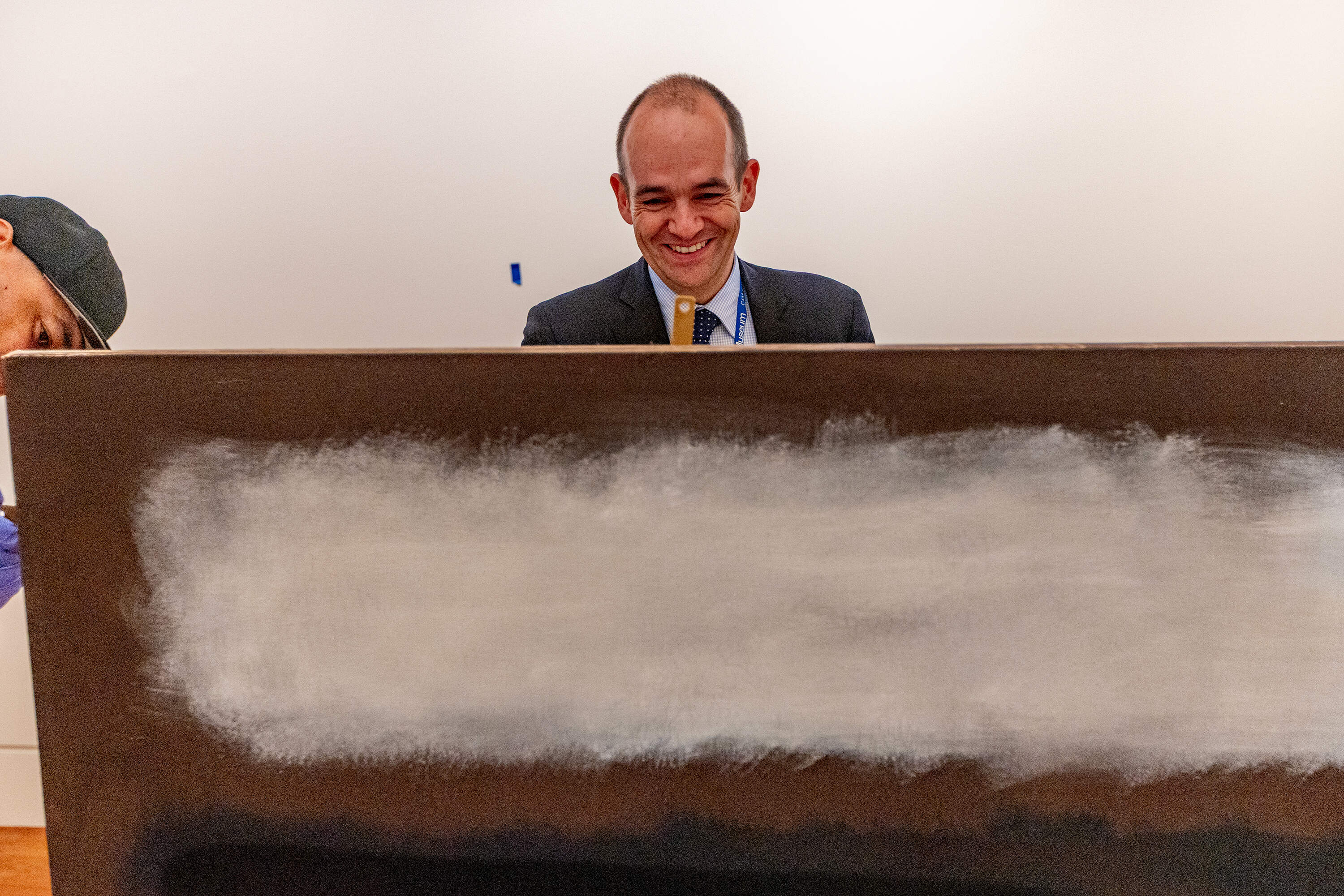
Cape Ann Museum director Oliver Barker is all smiles after the unpacking of the Rothko from the Modern Museum of Art. (Jesse Costa/WBUR)
“It’s what people think of when they hear the name Mark Rothko,” Eliza Rathbone said. She orchestrated the exhibition and is chief curator emerita at The Phillips Collection in Washington D.C. which also partnered on the show.
“What I’m excited about is that people will see works that they wouldn’t immediately expect,” Rathbone said, “and much earlier work when he was on Cape Ann with Milton Avery and Adolph Gottlieb.”
Milton Avery, right, photographed in Gloucester with his wife Sally circa 1930. (Courtesy Cape Ann Museum)
Milton Avery, a prolific painter known for his luminous landscapes, first visited Cape Ann in the 1920s. Other New York artists flocked there, including Edward Hopper, to escape the city’s summer heat. The peninsula’s famous light and dramatic terrain were also tantalizing. “It’s an artist’s paradise,” Rathbone said.
Rathbone herself moved to Cape Ann about a decade ago. Over her long career she curated separate shows on the three artists and their work. But while writing about Avery she had a revelation. Rathbone knew the artists were friends, but said she realized, “there had never been an exhibition about their friendship — at least not like this which follows it through three decades.”
In 1932 Avery invited Rothko and Gottlieb to Gloucester. They were both 18 years younger than Avery and still forging their paths. Avery set an example.
“He was really a mentor — not a teacher,” Rathbone said. “He didn’t tell anyone what to do. He just did what he was doing, and they did it too.”
Avery also showed his younger peers that pursuing the life of an artist was possible, even if it might not be a lucrative one.
Rathbone walked into a gallery hung with dozens of watercolors that look like postcards from the trio’s summer trips. Avery captured a scene in 1932 of people viewing a total solar eclipse at Good Harbor. Rothko recorded loose forms of bathers reclining on the sand, and figures playing handball.
Rathbone said the action scene was unusual for Rothko, but “playing handball is one of the things they did when they were young on the beach, tired of sketching and painting perhaps.”
Mark Rothko, “Untitled (bathers on the beach),” 1934. (National Gallery of Art, Washington, DC. Gift of The Mark Rothko Foundation, Inc. Kate Rothko Prizel & Christopher Rothko / Artists Rights Society (ARS), New York)
The three artists roamed around Gloucester hunting for subjects to document. So we walked down to the waterfront to experience how the country’s oldest seaport inspired them.
“When you look out on the harbor — and see the docks and piers and boats and reflections in the water and the light — it’s so recognizable. You see their work in these views,” Rathbone said, standing beside a pile of lobster traps as gulls screeched overhead.
Even detritus on the beach was captivating for Gottlieb, an Abstract Expressionist. Some of his Cape Ann paintings feature dead fish he gathered on the beach, then put into boxes. Rathbone said Gottlieb dove more deeply into surrealism in the 1940s.
The curator emphasized how those summers in Gloucester were critical to the three artists’ sense of what a painting could be. They evolved together, and the younger artists ultimately influenced Avery’s works on large canvases. In the show, their later abstract paintings fill a gallery of their own.
While Avery, Gottlieb and Rothko had different temperaments and backgrounds, they still formed something of a bromance. Rathbone laughed at that suggestion, then said, “Well, it was a strong one clearly, because it lasted throughout their lives.”
And now, decades after their deaths, they’re reunited in a show with many works never before seen by the public.
“They were created here, and they’ve remained with these artists’ estates,” Barker said. “And it is wonderful to think about the conversations that they would have had here about this place.”
Barker hopes “Avery, Gottlieb & Rothko: By the Sea” makes a big splash as its debut coincides with the Cape Ann Museum’s reopening after a 20-month renovation. The exhibition also marks the first time a show that originated there will travel. It heads to The Phillips Collection in October.
/wp-content/uploads/2023/08/logo.png00Haley Wolfe/wp-content/uploads/2023/08/logo.pngHaley Wolfe2026-06-30 09:50:122026-06-30 09:51:42WBUR: Cape Ann summers inspired lifelong ‘bromance’ between painters Rothko, Avery and Gottlieb
More than $20 million has been spent upgrading the Cape Ann Museum in Gloucester’s five-building footprint, including its historic 1806 captain’s house.
Following a 20-month closure, the Cape Ann Museum reopens its main downtown campus in Gloucester, MA to the public on June 30, 2026. More than $20 million has been spent upgrading the institution’s five-building footprint, including its historic 1806 captain’s house. Ship’s captain.
Gloucester, 35-miles up the coast from Boston, is the oldest seaport in the United States, founded in 1623 and named after the English hometown settler colonials arrived from.
Between the late 1800s and early 20th century, little Gloucester was America’s largest fishing port. That’s how you know Gloucester–how the world knows Gloucester–even if you don’t think you do. “The Perfect Storm.” George Clooney and Mark Wahlberg portrayed Gloucester fisherman on the doomed Andrea Gail. If you go, be sure to see the iconic Fisherman’s Memorial–the Man at the Wheel–featured in the movie. “They that go down to the sea in ships.”
Renovations to the Cape Ann Museum include a new showcase of the city’s deep history with the sea in a redesigned suite of three Fisheries Galleries telling captivating stories of the fishing industry, past and present. Fisherman still go out of Gloucester, although nowhere near the numbers of a century ago.
Upgrades across the campus included full guts of multiple buildings, new HVAC and climate control, electrical, plumbing, lighting, security systems–all the expensive, boring stuff visitors rarely recognize, but are essential when welcoming the public and housing priceless art and artifacts. Museum officials took great care not to change the nature of the institution despite its significant facelift.
“(The museum is) small and intimate; we are a regional museum, and we tell a very important local story, but one of national significance, and we do so in gallery spaces that are relatable,” Museum Director Oliver Barker told me via video interview. “We are not talking about these cavernous galleries that exist in metropolitan centers. We love that feel of intimacy here and wanted to keep that as part of the renovation.”
Campus wayfinding has been improved, the auditorium refurbished, the atrium reimagined, spaces for education upgraded, and a new archival display gallery added among other improvements.
Visitors begin with an introduction to the area’s indigenous people and their 12,000-plus year presence, then enter a gallery devoted to the fishing industry in its heyday. Cape Ann is also renowned as a popular artist’s retreat, particularly at the turn of the 20th century.
“That active fishing industry here, concurrent to that, there was also a granite boring industry, it made Gloucester a very real American place, and artists flocked here,” Barker explained. “We have the ability to show the art and also the objects, the industrial objects that inspired these artists so greatly. Anyone coming to the museum is going to have the opportunity to see the fine art and these industrial artifacts in juxtaposition. We believe that tells a much stronger story by putting these items in conversation.”
Paintings from American art titans are displayed alongside a Fresnel lens designed for one of two lighthouses on nearby Thatcher Island as an example. The Fresnel lens innovated a system of prisms that allowed lighthouses to shine out to sea by roughly 20 miles. Combined with Cape Ann’s northeasterly location along the East Coast jutting out into the Atlantic, the lighthouse would have been one of the first signs of human habitation people making the trip from Western Europe to America would have seen.
“There’s an opportunity to look at works that Winslow Homer made here during the course of five successive summers where he actually learned how to use watercolors as a medium,” Barker said. “As you’re looking literally at a fishing vessel or items that were used by fishermen as they were fishing out at the Grand Banks, you’ll see those items with work that Homer, Edward Hopper, so many other greats of American art, were making in response to being here.”
One fishing vessel on view recalls the grisly story of Howard Blackburn, a Gloucester fisherman who went out as part of a big schooner to the Grand Banks. He and his dory were overlooked and forgotten by the mothership in a fog leaving him and a compatriot at sea five days from land.
“The only way in which he was going to survive due to sleep deprivation and the awful conditions they were going to need to withstand, he actually froze his hands to the oars,” Barker said.
His shipmate perished. Blackburn received a hero’s welcome upon his return to Gloucester. The vessel on view at the Cape Ann Museum is one Blackburn would later guide across the Atlantic Ocean. Another small boat on view–20-footer–similarly made the transatlantic journey, this one stemming from a bar dare. Very on-brand for New England. Alfred Johnson in Centennial was the first to sail from Gloucester to Liverpool. Sixty-six days alone at sea.
“It’s part of a long history we have here of intrepid men and women who, against all odds, have succeeded,” Barker said.
The Artists Of Cape Ann
Milton Avery, ‘Harbor at Night,’ 1932. Oil on canvas, 32 x 48 in. The Phillips Collection, Washington, DC. Acquired 1942, 0038.
The Museum’s reopening is the capstone of its 150th anniversary and coincides with the launch of a major national exhibition also debuting on June 30, “Avery, Gottlieb & Rothko: By the Sea.” Presented in partnership with The Phillips Collection in Washington, D.C., the exhibition explores the relationship and artistic influence among three great American artists—Milton Avery (1885–1965), Mark Rothko (1903–1970), and Adolph Gottlieb (1903–1974)—as they summered together on Cape Ann during the 1920s through the 1940s.
“American artists at the turn of the 20th century were looking for distinctly American subject matter, and so Milton Avery came here, along with a group of fellow artists from Hartford, Connecticut, in the early 1920s,” Barker explained. “Our exhibition features two very early works that Milton Avery made when he was here in the 1920s painting in an American impressionist style. We know from the Gloucester DailyTimes, our local newspaper that is still very fortunately in print, that Milton Avenue is here, and he not only was here to paint, but he participated in the 300 plus celebrations for colonial arrival in 1923.”
1923 was the tricentennial of settler colonials founding Gloucester.
“Apparently, he dressed in traditional garb and was responsible for designing some of the floats that we used as part of the official celebrations,” Barker continued.
Avery met his wife Sally Michael–a hell of an artist in her own right–in Cape Ann and the couple honeymooned there in 1926 before moving to New York and meeting Gottlieb and Rothko.
“They admired the way in which Milton Avery was so committed to his own artistic practice, and as friends, initially in New York, they came here on successive occasions to Gloucester, summered here as a group, and our exhibition deals with that part of their story, a part of their story that has never been told,” Barker said. “We know about them as three New York-based artists, but the fact that they spent many seminal summers here on Cape Ann has not been featured.”
Eighty-two artworks are featured in the exhibition; three come from the Cape Ann Museum’s permanent collection, the others are loans from private collections, the nation’s most prestigious art museums including the Museum of Modern Art and the National Gallery, and the three artist’s estates.
“They’ve allowed us to bring out of their vaults things that have never before been seen. Over 40% of the work that we’ll be showing has not ever been on public view,” Barker said.
The presentation begins with Avery paintings from the 1920s and continues with artworks made towards the end of his life. Interestingly, while Avery began as an influence on the younger artists, he was 18 years older, Gottlieb and Rothko began influencing Avery later in life. The exhibition shows that changing dialog.
Mark Rothko In Gloucester
The shore, the sea, the horizon.
Mark Rothko.
His iconic fuzzy stacked squares and rectangles, his “planes of color.”
Did Cape Ann inspire one of art history’s most recognizable artistic signatures?
“Mark Rothko himself said that he saw a real through line in his work, and so anyone who comes here, when they step into the exhibition, if they do it in chronological order, one of the first things they’ll encounter is a painting that Mark Rothko made of fish drying on racks here on the Gloucester Harbor, and if you look at that, or if you look at paintings he was making that same year of figures lying on the beach, it’s very clear to see how he’s already simplifying his compositions,” Barker explains. “You can virtually see the horizon, the ocean, and the sand, and whether you choose to read those as the planes of color for which he is now better known, that’s obviously very subjective. I love that Rothko, in looking back on his own work, said that he could see how he got from where he was then (later in his career) to those earlier works he was making in places like Gloucester.”
“Avery, Gottlieb & Rothko: By the Sea” can be seen at the Cape Ann M through September 27, 2026, before traveling to The Phillips Collection, marking the first time an exhibition organized by the Cape Ann Museum will tour to a national museum.
/wp-content/uploads/2023/08/logo.png00Haley Wolfe/wp-content/uploads/2023/08/logo.pngHaley Wolfe2026-06-29 16:36:242026-06-29 16:36:43Forbes: Cape Ann Museum Reopens After 20-Month Renovation


 A gallery at the Cape Ann Museum for the show “Avery, Gottlieb and Rothko: By the Sea.”/ETHAN M. FORMAN