Gloucester artist Leon Doucette, Assistant Curator at Cape Ann Museum, has taken on a new role as Curator of the Collections.
Doucette, a Gloucester native, has been a key member of curatorial department since 2011, working alongside Chief Curator Martha Oaks, in the Henrietta Gates & Heaton Robertson endowed position. In his new role, Doucette will oversee the management, interpretation, and ongoing development of the museum’s permanent collection.
“We are delighted to recognize Leon with this important new role. This promotion reflects Leon’s essential contributions to the museum and the high regard in which we hold his work at Cape Ann Museum,” Director Oliver Barker said.
Doucette’s position is a new one at the museum, which is now in the search process for a new chief curator to succeed Oaks when she retires.
“This is a story of someone born here whose tenacity, hard work, and research have earned recognition for his outstanding work,” Barker said. “Through Leon’s scholarship and storytelling, he is bringing Cape Ann’s rich history to life for an ever-widening audience, both locally and nationally.”
Doucette, who previously served on Gloucester’s Historical Commission, understands what makes Cape Ann singularly unique, and brings that insight and passion to everything he does, said Barker.
The museum’s collections share what Cape Ann is known for — its granite and fishing industries and the celebrated artists who have flocked here, drawn to its coastal panoramas, natural beauty and working waterfront.
Doucette holds a degree from the New Hampshire Institute of Art, where he studied art and art history. Influenced by late-19th century French ateliers, his formal training emphasized observational drawing, painting, lithography, and figure sculpture, according to his bio.
“His deep knowledge of the museum’s vast and growing collections gives him a rare ability to see the connections among the people, places, objects and stories that have shaped this community,” Barker said. “His understanding of Cape Ann’s long history is matched by an exceptional artistic eye and an unrivaled commitment to preserving and sharing this place.”
Over the years, Doucette’s responsibilities have grown at the museum, which was founded 151 years ago.
“It has been immensely rewarding to watch Leon assume vital leadership in shaping our major exhibitions, including those on Edward Hopper, Milton Avery, Adolph Gottlieb, and Mark Rothko,” Oaks said. “Cape Ann Museum is fortunate to have him step into the role of Curator of the Collections, bringing his knowledge, vision and dedication to our institution.”
Working with the museum’s collections team and guest curators, Doucette has taken a leadership role over the past 15 years, including his work with milestone exhibitions, including “John Sloan: Gloucester Days” in 2015, “Drawn from Nature & on Stone: The Lithographs of Fitz Henry Lane” in 2018, “Homer at the Beach: A Marine Painter’s Journey” in 2019, “Edward Hopper & Cape Ann: Illuminating an American Landscape” in 2023, and this year, “Avery, Gottlieb & Rothko: By the Sea.”
In other efforts, Doucette has served as a longstanding member of the museum’s Collections Committee, and helped lead the development of the museum’s Contemporary Art Subcommittee.
An award-winning artist, Doucette has served as a juror for the North Shore Arts Association, Marblehead Arts Association, and Cape Ann Plein Air. Awards for his work include gold medals from the Guild of Boston Artists and Rockport Art Association & Museum as well as First Place in the Portrait Society of America’s International Portrait Competition. He also has led drawing workshops at the museum.
/wp-content/uploads/2023/08/logo.png00Haley Wolfe/wp-content/uploads/2023/08/logo.pngHaley Wolfe2026-10-23 10:25:552026-10-23 10:25:55Gloucester Daily Times: Gloucester artist and curator takes on a new position at Cape Ann Museum
For years, a copy of Coming to Light sat in a stack of books in my Midtown apartment. It’s a catalog from a 2002 exhibition at Knoedler & Company in New York devoted to the summers Milton Avery, Adolph Gottlieb, and Mark Rothko spent in Provincetown between 1957 and 1961.
Each summer, the catalog made the pilgrimage to Provincetown in my suitcase, packed with the best intentions of reading it on the beach, only to return to the same stack unread. From the markings inside, it looks like I bought it at Tim’s Used Books. Its luck changed late this summer, when news of an exhibition in Gloucester reminded me to pick it up again.
“Avery, Gottlieb & Rothko: By the Sea” was on view at the Cape Ann Museum in Gloucester from June 30 to Sept. 27 and is opening on Oct. 24 at the Phillips Collection in Washington, D.C. The show tells the story of that other Cape, where Avery, Gottlieb, and Rothko spent summers together before their Provincetown years.
The curator, Eliza Rathbone, acknowledges a debt to the Knoedler exhibition. She began her career at the National Gallery of Art under E. A. Carmean Jr., who organized the Knoedler show, and in the new catalog’s acknowledgments she credits it with having “triggered my own interest” in the artists’ earlier summers by the sea. The two shows even share a painting, Gottlieb’s Blue at Night (1957).
The Gloucester story begins in 1920, when Avery discovered the coastal city and made it his summer home. By the decade’s end, he had taken two young painters under his wing: Rothko, a fixture at the Averys’ cramped New York City apartment, and Gottlieb, who had joined the circle by 1929. In 1932, Avery had brought his young friends to Cape Ann, and by 1934, the Gottliebs and the Rothkos had joined the Averys for the summer, renting houses on Calder Street in East Gloucester.
The exhibition gathers 82 works from 26 lenders including 16 museums across the country. At the Cape Ann Museum, Rathbone essentially split the show in two. To the right of the entrance, an airy gallery held the major late canvases of each artist. To the left, a series of more intimate rooms traced their story chronologically, with early paintings, watercolors, and sketches arranged alongside photographs and biographical material. Nearly half the works have never been shown publicly, and presented in this context, the pictures begin to read like an archive.
In the side galleries, the work looks less like an art movement in the making than a summer well spent. Much of it is small and quick: sketches and watercolors made from life by friends who escaped the city to paint together, trying out subjects — bathers, boats, beaches, and the obligatory harbor view. There’s a looseness to it, a freedom from the pressure to arrive at a signature style. For Avery especially, these pictures were raw material; his routine was “sketches in the summer, into paintings over the winter” as described in Coming to Light.
The common thread is Avery’s influence, which shows in the flattened space, the simplified forms, and the color doing most of the work. Well before Rothko and Gottlieb turned to abstraction, they were already learning to pare down what they saw. That common ground cuts both ways. At times, the installation repeats itself with one harbor view echoing the last, and telling whose is whose isn’t always easy. Avery’s Red Sky, Blue Sea (1958), a broad field of blue held between bands of orangish red and yellow, soft-edged and nearly weightless, could pass for a Rothko. Rothko’s Untitled (bathers on the beach) (1934), with three reclining figures drifting across flat planes of color that only hint at a beach, could pass for an Avery. Swap the labels, and few visitors would notice.
Largely overlooked are the women of this artistic circle. The exhibition catalog notes that Sally Avery, Esther Gottlieb, and Rothko’s first wife, Edith Sachar, were all working artists at the time and part of “the conversations and the work,” yet Sally, who supported the family by designing ads for the New York Times while Milton painted, is the only one who gets a single small watercolor here.
Across the hall, the main gallery held a commanding presentation of their signature works: Rothko’s hovering fields of color, Gottlieb’s emphatic forms, and Avery’s late seascapes. The shared maritime subjects of the smaller rooms have given way to three increasingly distinct languages. What the Gloucester work makes visible is how close they once were and how differently each carried those early experiments in simplification, color, and abstraction forward. It’s easy to read the room as a conclusion, proof of how far the three painters traveled from those Gloucester summers. But Coming to Light suggests the room is also the beginning of a new chapter.
The best evidence hides in plain sight, both in the exhibition and on the cover of the new catalog. Avery’s Black Sea (1959) reduces a shoreline to its essentials: black water, a jagged line of white surf, and pale sand. The catalog also names where it came from, a beach in Provincetown, which makes the emblem of the Cape Ann exhibition a picture of the other Cape.
In Gloucester, the younger painters had followed their mentor; in Provincetown, the mentor followed them. Gottlieb arrived in Provincetown first. He had been spending summers here since the mid-1940s, and he took part in Forum 49, held in 1949 at 200 Commercial St., a onetime Ford garage now shared by Kiehl’s and Toys of Eros. The Averys came for brief visits in 1955 and 1956; after the second visit, they wrote to friends that they “fell in love with the place.” In 1957, they settled in for the summer, as did Rothko, who bought an unassuming house at 250 Bradford St. the following year and turned its entire second floor into a studio. He once described his “ideal life” as one in which artists worked alone all day and met every evening to talk, much as the three friends had done in Gloucester a quarter century earlier.
Carmean, the organizer of the Knoedler show, calls the summer of 1957 “a regathering of painters whose close association dated back almost three decades.” It had been 14 years since they last were together in Gloucester, and by 1957 all three were widely recognized; nobody was leading, and the lines of influence ran in every direction. That exchange wasn’t always comfortably acknowledged: Rothko resisted references to Avery’s influence, while Avery denied ever having been his “teacher.”
The next summer, Avery broke his routine and began painting big canvases on the spot, “like the abstract boys,” as he told Nat Halper, whose H.C.E. Gallery in Provincetown showed them that season. “We pulled them up on a rope,” Sally recalled, and she credited Rothko with giving her husband “the courage to do it.”
The summer of 1957 would be their only one together in Provincetown; Gottlieb was already on his way out. He is reputed to have said, “When you are a young artist, Provincetown is the place to be. When you make it, move to East Hampton.” Gottlieb apparently took his own advice.
Provincetown is very good at claiming its artists, and Gloucester has every reason to do the same, but Avery, Gottlieb, and Rothko probably didn’t stay put long enough to belong to either. Artists move. Friendships move with them.
Gloucester and Provincetown are two Capes where Avery, Gottlieb, and Rothko engaged in a conversation spanning more than 30 years. Avery liked to sit out in the evenings on his deck facing Provincetown Harbor, watching the Moon rise over the water, a view he painted as Tangerine Moon and Wine Dark Sea (1959). Two exhibition catalogs now sit side by side on my shelf here in Provincetown as the Sun goes down over the same bay, somewhere toward Gloucester.
/wp-content/uploads/2023/08/logo.png00Haley Wolfe/wp-content/uploads/2023/08/logo.pngHaley Wolfe2026-10-22 10:16:482026-10-22 10:16:48The Provincetown Independent: Avery, Gottlieb, Rothko, and the Other Cape
With just days to go before the conclusion of Cape Ann Museum’s special exhibition “Avery, Gottlieb & Rothko: By the Sea,” the museum announced the gift of an artwork from the Adolph & Esther Gottlieb Foundation.
The 1936 painting by Adolph Gottlieb (1903–1974) is among the more than 82 artworks featured in this ground-breaking show.
Sanford Hirsch, executive director of the Gottlieb Foundation for 50 years, said the gift was in recognition of the exceptional efforts of the Cape Ann Museum and Guest Curator Eliza Rathbone in organizing the exhibition, and in appreciation of the “great support and interest in this exhibition and these artists shown by the community of Cape Ann.”
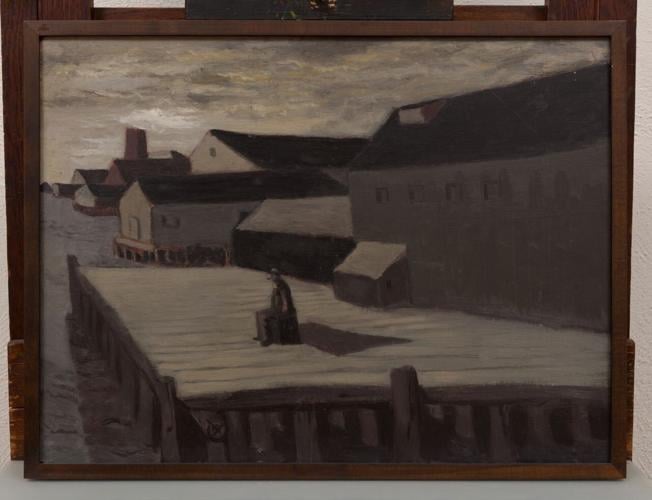
The painting is untitled, an 18- by 24-inch oil on Masonite.
“This gift is to become part of its permanent collection and to further its purpose as a museum to preserve and celebrate the history and culture of the region,” Hirsch said in the announcement.
More than 25,000 people have visited the exhibition since it opened June 30. The show closes this Sunday, Sept. 27.
Hirsch said the artwork represents an important transitional painting based on sketches the artist made of the piers in Gloucester during one of his many summers on Cape Ann.
“The painting depicts a lone figure on a pier, a gray presence on a gray day, in a manner that shows his early interest in Surrealism. It is fitting that this painting will belong to the community where it was conceived, and it is our hope that it will continue to be valued by this and future generations of Cape Ann’s citizens and visitors,” Hirsch said.
Museum Director Oliver Barker said the donated painting is an unexpected and much appreciated gift.
The untitled artwork of the lone man sitting on an empty dock is devoid of any fishing- or maritime-related activity, and illustrated in somber tones. It was created in 1936, in the midst of the Great Depression.
Barker said the Gottlieb painting also is important because it represents when Cape Ann’s once thriving granite industry faced economic uncertainty during the Great Depression.
The museum community is thrilled about this gift.
“This work makes an important contribution to the museum following such a successful exhibition, and it is especially meaningful because the Gottlieb Foundation does not typically make institutional donations like this,” Barker said. “The foundation’s decision was inspired by their partnership with the museum and their recognition of how warmly this community embraced the exhibition. That is truly powerful.”
The special exhibition shares the story of three New York artists and friends — Gottlieb, Mark Rothko (1903-1970) and Milton Avery (1885–1965) — who summered together on Cape Ann on and off for more than three decades.
Founded in 1976, the Gottlieb Foundation has two main purposes: to offer individual visual artists annual grants and a separate program to support visual artists in emergencies; and to utilize its collection of art to organize or lend to relevant public exhibitions.
This Gottlieb painting is the second artwork connected to the special exhibition to be donated to Cape Ann Museum, which celebrated 150 years in 2025.
Last month, Rothko’s son, Dr. Christopher Rothko, gifted his father’s 1934 watercolor and gouache painting “Untitled (wharf, Gloucester, Massachusetts),” to the museum’s permanent collection.
This special exhibition was guest-curated by Rathbone, chief curator emerita at The Phillips Collection, whose close connection to the artists’ families enabled her to uncover new insights into their summers on Cape Ann, and its lasting influence on this trio of artists.
When the exhibition closes in Gloucester, it moves to The Phillips Collection in Washington, D.C., marking the first time a Cape Ann Museum exhibition will tour to a national museum.
/wp-content/uploads/2023/08/logo.png00Haley Wolfe/wp-content/uploads/2023/08/logo.pngHaley Wolfe2026-10-02 12:03:322026-10-02 12:03:32Gloucester Daily Times: Cape Ann Museum receives a gift of Gottlieb painting
The Cape Ann Museum’s “Avery, Gottlieb & Rothko: By the Sea” has been one of the most popular shows in the museum’s history. It closed Sunday. In August, Mark Rothko’s son, Christopher, announced the donation to CAM of a watercolor by his father. Last week, the Adolph & Esther Gottlieb Foundation announced the gift of a 1936 oil painting to the museum. “It is fitting that this painting will belong to the community where it was conceived,” said Sanford Hirsch, the foundation’s executive director. Later this month, the exhibition opens at the Phillips Collection, in Washington, D.C. — Mark Feeney
/wp-content/uploads/2023/08/logo.png00Haley Wolfe/wp-content/uploads/2023/08/logo.pngHaley Wolfe2026-10-02 10:15:142026-10-02 10:15:14Boston Globe: A Gottlieb donation for CAM
Let’s go to the beach! I know summer is over, but if you subscribe to poet Rene Ricard’s credo, “never get a job, never take a vacation,” then the beach is always open. Milton Avery, Mark Rothko, and Adolph Gottlieb never took vacations even when they went to the beach. What they did there is the subject of a revelatory exhibition at the renovated and lovely Cape Ann Museum, in Gloucester, Massachusetts. The exhibition will travel to the Phillips Collection, in Washington, DC, the collaborating institution, but close to the beach was the right place to see Avery, Gottlieb & Rothko: By the Sea.
The beach in question was not one made famous by artists and celebrities. Not Truro, on Cape Cod, and certainly not the Hamptons, but instead the one near the working-class fisherman’s town of Gloucester. Between 1932 and the late ’40s the three friends and their families took time from their urban studios to do something that liberated their work: they looked at the water, and everything around it—including people, landscapes, and the town itself. They also looked at each other’s work. The reactions each had to the place and to their visual conversations would have a profound impact on American art.
That’s the explicit argument here, and the circumstantial evidence was most convincingly displayed in one room of the exhibition, containing a collection of later masterworks by all three artists: among others, Rothko’s Untitled (Yellow, Pink, Yellow on Light Pink) (1955), Gottlieb’s Under and Over (1959), and Avery’s The White Wave (1956). The influence of nature on Avery is the most obvious and perhaps the least interesting. His work seems to follow the reductive path articulated by critic Clement Greenberg: that Avery was in Gloucester first, an established artist who was already well along that trajectory—away from Pierre Bonnard and Henri Matisse toward flattened, abstracted forms—when he encouraged the two younger artists to join him on Cape Ann. He had probably already forgotten more about color than either of the other two would ever truly know, and they both revered him not just as a mentor but, in Gottlieb’s words, “a great artist.” Avery never does away with nature, a reason why his paintings are so appealing, even when they get big and a bit empty. In a smaller work like The White Wave, the graphic simplicity and flat surface pack a wallop.
Rothko’s relation to the open air is more complicated. All three artists sketched people on the beach, but where Avery’s blocky bathers show a clear inclination toward reduction, Rothko’s watercolor beachgoers are more like blots, a response to the color of things. His metaphysical musings and ambivalence about hiking aside (his friend Joseph Liss described him as “not much of a nature man”), Rothko seems never far from the complexities of atmosphere, in search of a method to render a new nature from the inside. Likewise, when he turns his eye on the wharf, it becomes an architecture of formal energy and color relations.
Gottlieb was the one most heavily influenced by Surrealism, and Gloucester gave him the occasion to begin incorporating its various symbolic elements. Two small oils, Gloucester Street (1934) and Rockport (1932), a nearby town on Cape Ann, have the arid mystery of Giorgio de Chirico’s artificial landscapes. In later paintings, the beach becomes a kind of stage for boxlike structures containing seashore items such as fish and seashells, which take on a dreamlike significance. It’s not a long step from that to the flat grids of psycho-mythic symbols that defined his work in the 1940s. Of course, coherence is always imputed retrospectively, which may be why nature is so important for this exhibition, for provoking surprise. Being at the beach gave the artists permission—to play, to find a path, to diverge. One of my favorite Rothkos epitomizes it: Iphigenia and the Sea/Horizontal Phantasy (1943). With its classical reference, biomorphic forms, and even what appears to be a beach umbrella, the artist was working through Pablo Picasso’s persistent influence, and having some fun.
Of course, Gloucester was a real place, where people worked and struggled, not just lounged at the beach. Those troubles rarely show up, even in the sketches and notebooks. Even Avery, the long-timer and member of the local art society, appreciates Gloucester primarily for the play of weather, mood, and rough architecture. Of course, if anything is real to a Gloucesterman, it’s the weather, and Avery evokes it in dark paintings of the harbor. It is a striking progress from the diaphanous Post-Impressionism of Gloucester Dawn (1921) to the stark Harbor at Night (1932). Gottlieb’s sketches of the wharf are very much about booms, cranes, and fishing boats, but nowhere in any of the pictures is anyone hauling in a fish or mending a net. Only Avery nods briefly to the fisherman. I sense an assiduous avoidance of the picturesque, on the one hand, and the pitfall of social realism on the other. That isn’t why they came to the beach.
Also largely missing is Sally Michel Avery, the artist’s wife, and an artist in her own right. She was represented by only one small watercolor, but as the catalogue suggests, she was far more active in the discussions and painting sessions than the show implies, and she was important to Avery for more than just getting him up off the couch and to work. Of course, it makes sense to focus on the Big Three, but that single painting introduced a note of incompleteness to the origin story this entrancing exhibition sought to tell.
/wp-content/uploads/2023/08/logo.png00Haley Wolfe/wp-content/uploads/2023/08/logo.pngHaley Wolfe2026-10-01 09:24:142026-10-01 09:24:14Brooklyn Rail: Avery, Gottlieb & Rothko: By the Sea