
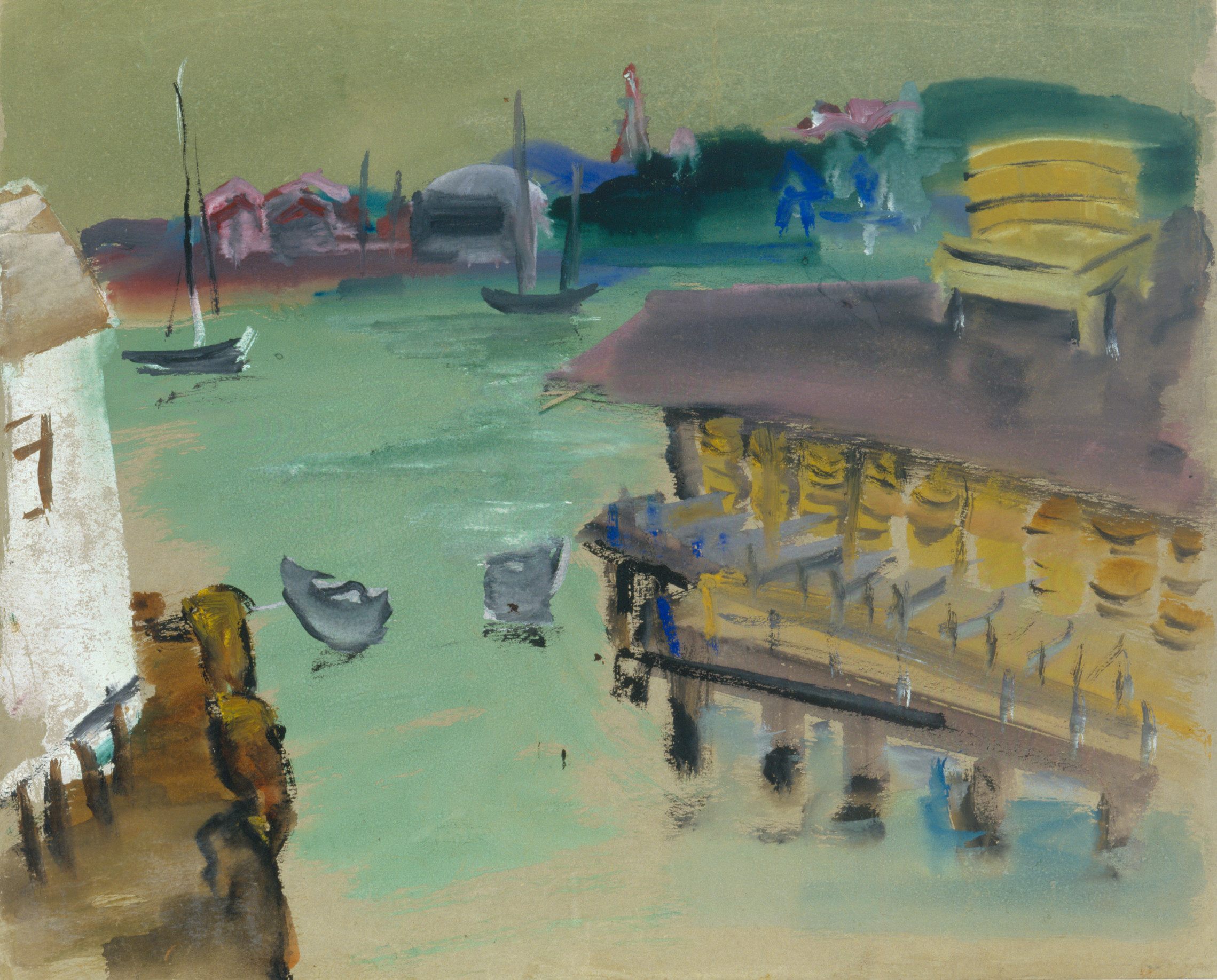
De Hirsh Margules, Mother Ann Lighthouse, Eastern Point, Gloucester, 1946. Gouache on paper. Gift of Jean M. Horblit, 2002. [Acc. #2002.004.002]
Boston Globe: In this early Rothko, we glimpse an artist embraced by friendships that helped him learn his own ethereal language
‘Rothko looked out and saw a landscape, indistinct, misted, veiled and changeable, ever changeable’
By Murray Whyte | September 4, 2026
Mark Rothko, Untitled (wharf, Gloucester, Massachusetts), 1934. • Cape Ann Museum
A little painting by Mark Rothko was recently gifted to the Cape Ann Museum in Gloucester, a gesture of gratitude and appreciation from the artist’s son and keeper of faith, Christopher, for its dazzling summer smash-hit “Avery, Gottlieb & Rothko: By the Sea,” which continues to pack its galleries all the way through Sept. 27. It’s hanging there now, in its little silvery frame; but past that, there’s nothing small about it. In its soft, dissolving stain of watercolor, it’s Gloucester, through and through — a tawny-colored wharf on the harbor, small boats dotting the calm green seas under the soft mist of simmering gray cloud, the headlands of Rocky Neck looming low across the water. But it’s also Rothko — so Rothko, a clear and bracing tease at the vanguard painter he would become, above any other in American art history.
In American art, Rothko is the inevitability: monastic, austere, a high priest of restraint who conjured forth on his big canvases great banks of colored fog that tease at the ineffable. In Houston, works like these fill the Rothko Chapel, so named not for any religious affiliation but for the deep spirituality his works can evoke (three works from that mature period grace a cathedral-like gallery in Gloucester, too). Rothko, for many, has come to transcend the world of art, a mystic whose work offers a glimpse of a realm beyond this earthly plane.
His work is a touchstone, often, not only for what came next, but before. On a recent visit to Tate Britain in London, I saw one of his oblique, beautiful abstractions — soft blocks of mustard, olive, and lavender — hung amid the museum’s spectacular permanent collection of J.M.W. Turner paintings, a master himself of the atmospheric, enigmatic sublime. Together, they felt primal, as mutable and inescapable as weather, and just as captivating (speaking of spiritual communion: I waited and waited, but the couple in the photo simply would not move, drinking it in for half an hour or more. This happens a lot).
Alongside Turner’s churning seascapes, Rothko’s dusky yellow, his seafoam green, sent my mind from London right back to this very painting. I’d seen it in Gloucester only days before. Holding both in your mind at once, you’re reminded, importantly, that Rothko was at one point an artist much like any other: trying, failing, and trying again to find the visual language that would give his ambitions life in the world. It didn’t come easily, or without trial. As a young painter, he adored Henri Matisse, though the loose, expressive but still embodying figuration of the Modern master eluded him; at the Gloucester show, beach scenes daubed in watery hues feature disproportionate blobs of flesh, void of finicky bits like faces and hands (not, he’d admit, his strength).

Hindsight colors those pictures in rosy admiration: Here he was, forging a path to the misty, billowing blocks that would come to define his oeuvre, and then a generation of American art. Maybe so. But he didn’t do so in solitude. Rothko’s Gloucester experiments took place in the loving embrace of close friendship of his painting confreres Milton Avery, Adolph Gottlieb, and their families; Rothko, so often seen as an inscrutable solipsist, alone in his tower of singular painterly ambition, lived in the fullness of community and familial bliss. At CAM, the painting is hung right now alongside wharf paintings by Avery and Gottlieb, too. The point is clear: Here, he was held up, supported, and loved.
That, I think, is why he was free to push further into the oblique, near-holy realm that he alone reached. Rothkophiles will know he didn’t emerge fully-formed, an intuitive sage manifesting an oblique sublime. He experimented: After Matisse, he turned to Kandinsky, taking inspiration from the Russian avant-gardist’s proto-abstract works to create microbial petri-dish abstractions of hectic scatters of eclectic forms.

That came after the wharf, the beach, the sea, sand, and sky — a departure, I like to think, before the inevitable return. On that Gloucester wharf, that day, Rothko looked out and saw a landscape, indistinct, misted, veiled and changeable, ever changeable. He saw a world shifting before his eyes, moments escaping, one by one, that he would never fully grasp. What he saw, finally, was his future.
“Avery, Gottlieb, & Rothko: By the Sea” continues at the Cape Ann Museum through Sept. 27.
To read the full article, click here.
